
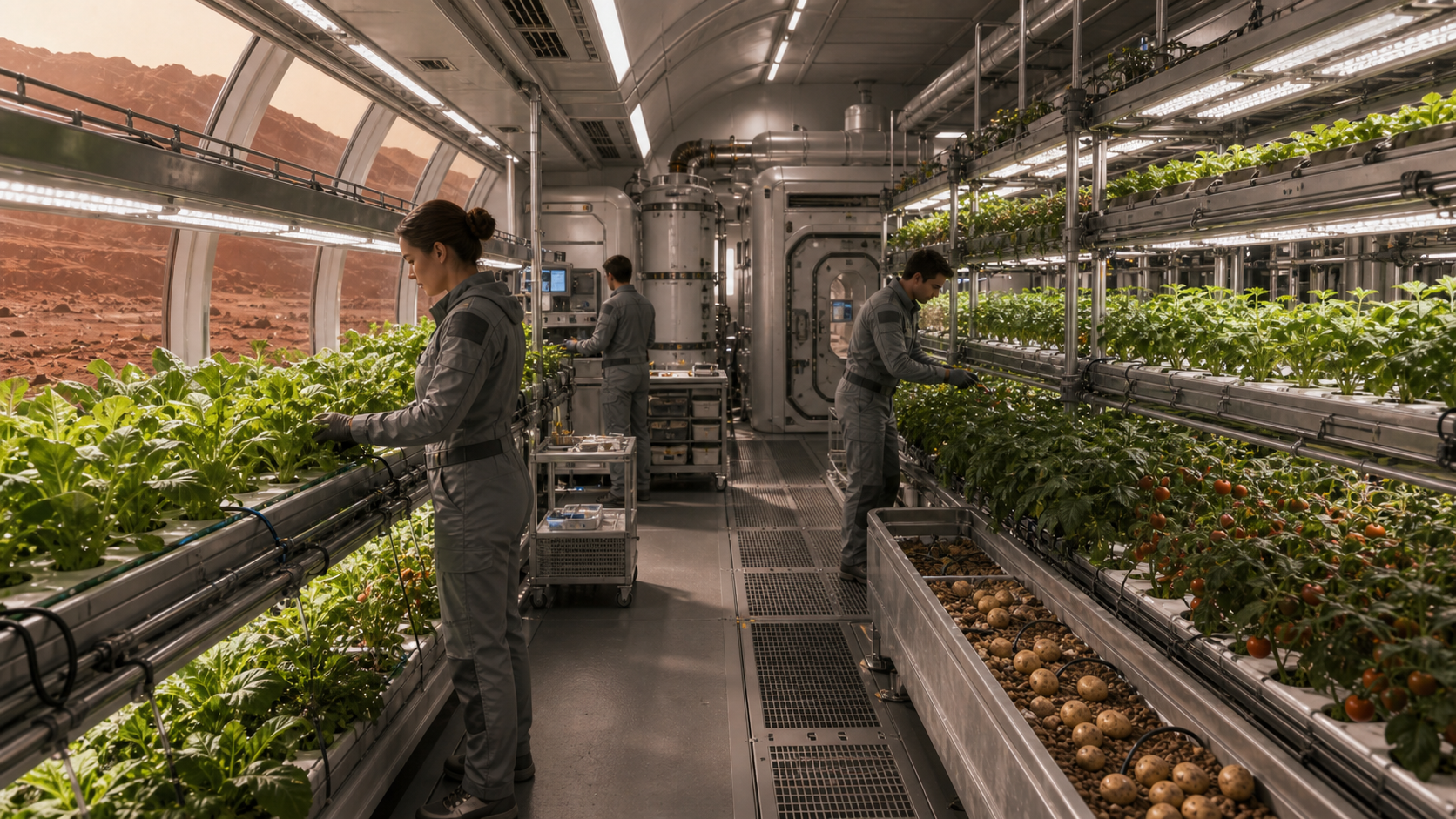
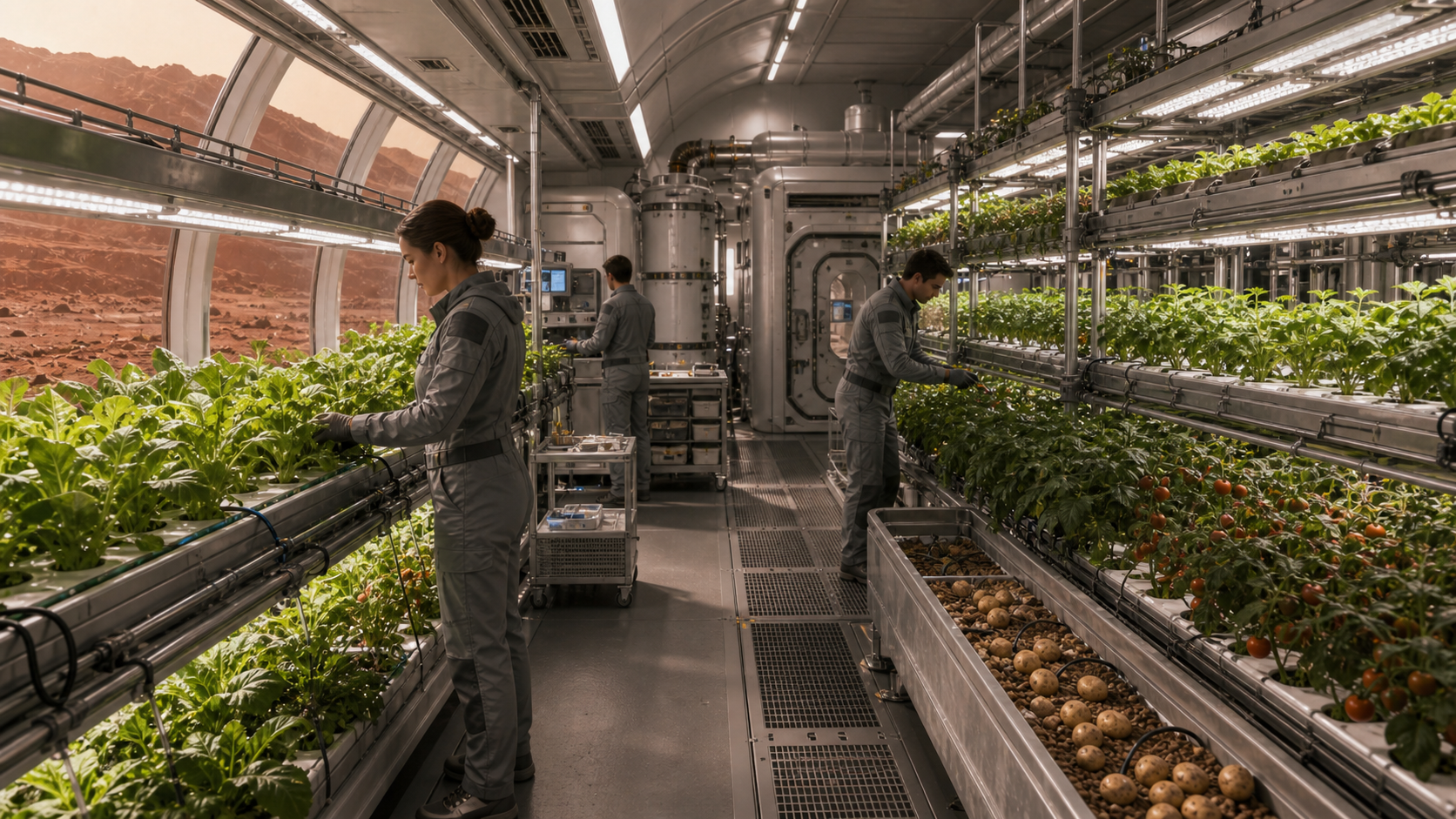
A Mars city does not become real when the first habitat lands. It becomes real when dinner stops depending entirely on Earth.
Food is one of the hardest parts of settlement because it is both biology and logistics. Every person needs calories, protein, fats, vitamins, minerals, water, taste, variety, and food safety. Every crop needs light, temperature control, humidity control, nutrients, carbon dioxide, clean water, pollination or seed handling, disease monitoring, harvest labor, and waste processing. On Earth, agriculture hides inside a planet-sized support system. On Mars, the farm is inside the life-support system.
For a small exploration crew, stored food can carry much of the burden. NASA’s Space Food Systems work focuses on safe, nutritious, acceptable foods for missions where shelf life and limited resources matter. But a city of hundreds or thousands cannot treat food as a shipment forever. A growing settlement has to produce fresh crops locally, recycle nutrients, supplement stored supplies, and make enough reserve capacity to survive crop failures.
Stored Food Comes First, but It Cannot Be the End
The first Mars crews will almost certainly eat mostly stored food. It is predictable, compact, tested, and far less risky than trusting a brand-new farm on day one. Food sent from Earth can include freeze-dried meals, thermostabilized pouches, grains, oils, supplements, emergency rations, and high-value ingredients that are difficult to grow locally.
Yet stored food has limits. Long-duration mission food must remain safe, nutritious, and palatable for years. Some nutrients degrade over time. Menus become repetitive. Packaging creates waste. Every kilogram launched from Earth competes with machinery, medicine, spare parts, and people. For migration-scale Mars, stored food becomes a bridge, not a permanent answer.
The practical transition would be gradual. Early settlers might grow fresh greens for morale and nutrition while still relying on imported staples. Later farms would add higher-calorie crops, protein systems, seed production, and closed-loop nutrient recovery. A mature city would still import some specialty foods, but its daily survival would come from local production.
Hydroponics Is the Obvious Starting Point
Mars farming will not begin with open fields. The atmosphere is too thin, the surface too cold, the radiation too high, and the soil chemistry too difficult. Instead, early farms will be sealed controlled-environment systems: pressurized rooms where plants grow in water-based nutrient solutions, inert substrates, or misted root chambers.
NASA has already spent years learning how plants behave in space through systems such as Veggie and the Advanced Plant Habitat aboard the International Space Station. Veggie grows fresh vegetables for astronauts and plant research, while the Advanced Plant Habitat is a larger automated growth chamber that controls air, temperature, humidity, water, and lighting. Those facilities are not Mars city farms, but they are stepping stones toward understanding crop growth, food safety, crew interaction, and plant biology beyond Earth.
Hydroponics has obvious advantages for Mars. It can use water efficiently, keep nutrients measurable, avoid uncertain native soil, and fit into stacked racks. It also lets engineers adjust light spectra, carbon dioxide, temperature, and humidity to optimize growth. The weakness is dependence on pumps, sensors, filters, clean plumbing, and steady power. A hydroponic Mars farm is not just a greenhouse. It is a machine full of living parts.
Aeroponics Saves Water but Raises the Stakes
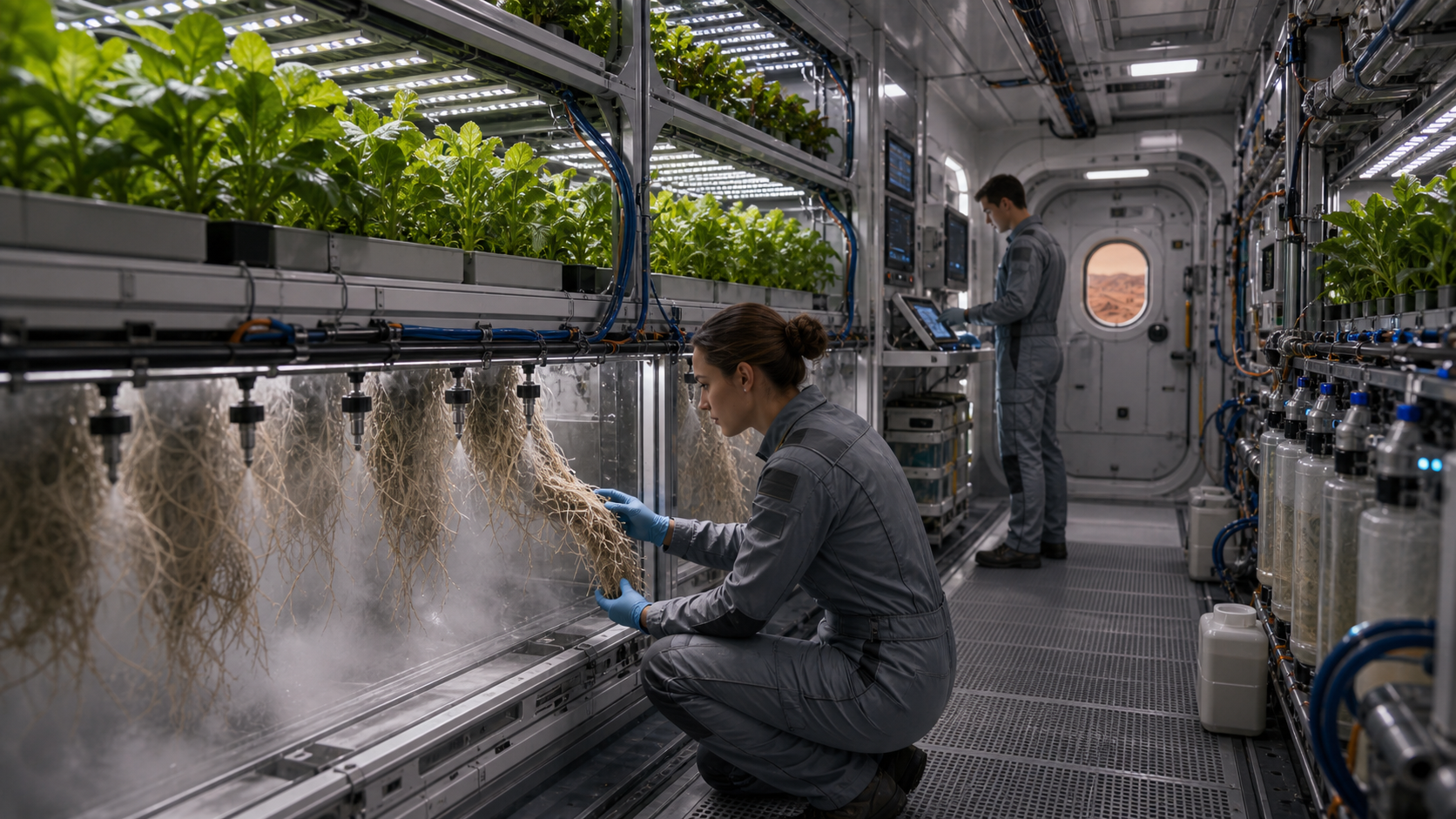
Aeroponics pushes controlled farming further. Instead of sitting in soil or nutrient solution, plant roots hang in air and receive a fine mist of water and nutrients. On Mars, that could reduce water use, lower the mass of growing media, and make root health easier to inspect.
The tradeoff is fragility. If a pump stops, a nozzle clogs, or a control system fails, roots can dry quickly. A disease in a root chamber could spread through shared plumbing. In a settlement where food security matters, aeroponics would need redundancy: backup pumps, isolated crop zones, spare nozzles, manual recovery modes, and constant monitoring.
That does not make aeroponics a bad idea. It may be ideal for high-value crops, seed production, rapid growth experiments, and systems where water conservation is critical. But it shows a central Mars farming rule: efficiency is useful only if the system remains survivable when hardware breaks.
Crop Selection Is a City-Level Decision
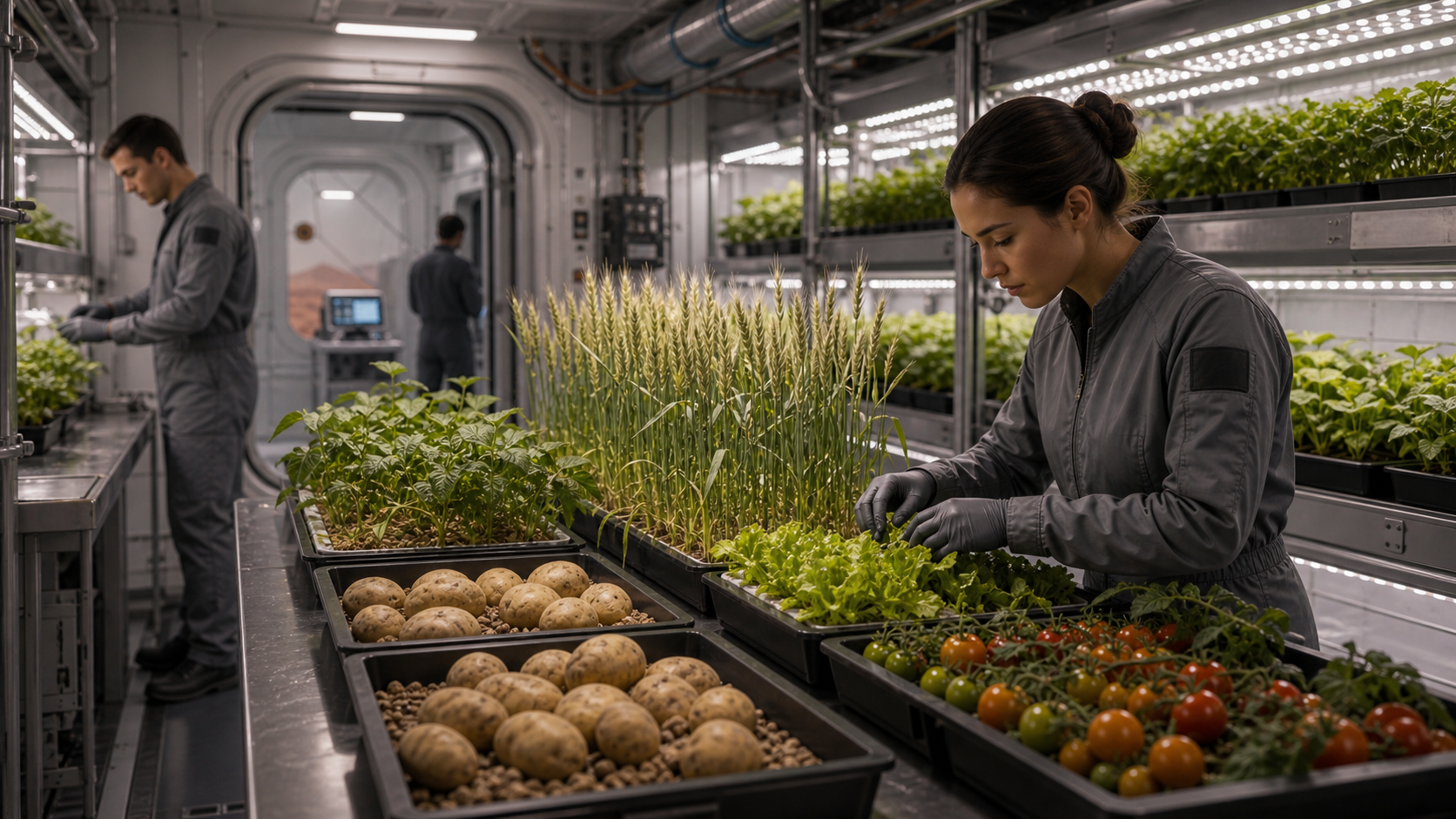
A Mars menu cannot be chosen only by what people like. Crops must earn their space, light, water, nutrients, labor, and risk. Leafy greens grow quickly and add freshness, vitamins, and morale, but they are not dense calorie sources. Potatoes and sweet potatoes can produce useful calories, but they need volume and careful disease control. Wheat, rice, or other grains are culturally important and calorie-rich, but processing them into food adds equipment and labor. Beans, peas, soy, or lentils can provide protein, but they require crop management and may have longer growth cycles.
A real crop plan would likely mix categories. Fast greens for fresh nutrition. Root crops for calories. Legumes or soy for protein. Small fruiting crops like tomatoes, peppers, or strawberries for morale and micronutrients. Herbs for flavor. Seed crops to preserve independence. The result would not look like a luxury market. It would look like a carefully engineered diet.
Greenhouse size then becomes a hard constraint. A city feeding thousands would need enormous productive area if it relied mostly on plants. Stacking crops vertically helps, but light, heat removal, humidity, crew access, and maintenance corridors still take space. Artificial lighting gives control but demands power. Sunlight through shielded greenhouse windows can help, but Mars receives less sunlight than Earth and dust storms can reduce it further. Food production will be tied directly to the power system.
Algae and Microbes Could Fill Nutritional Gaps
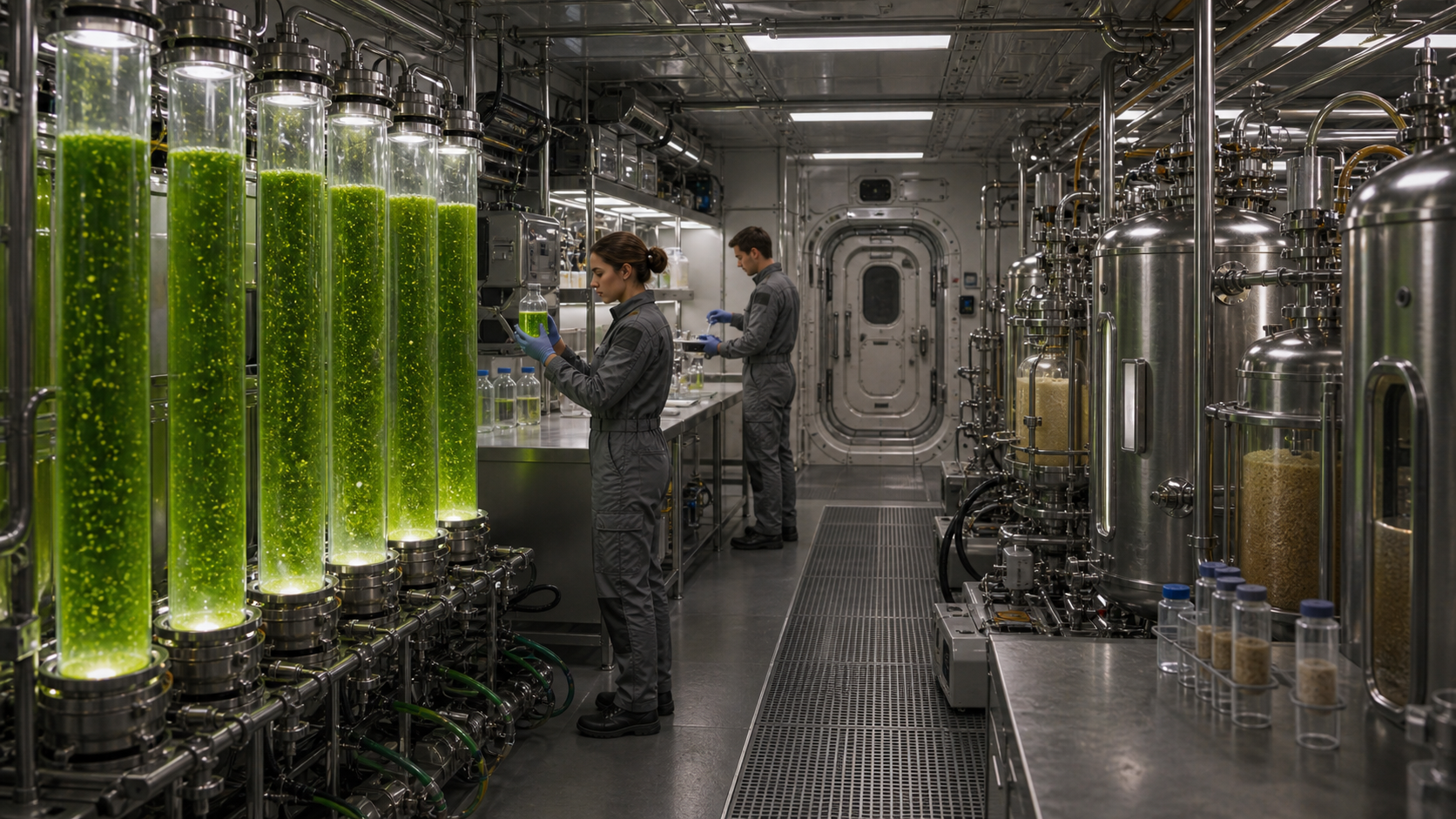
Plants will not be the only food system on Mars. Algae and microorganisms may become crucial because they can grow in compact bioreactors, use controlled inputs, and produce specific nutrients or proteins. NASA’s BioNutrients work is already testing microbial production of essential nutrients for long-duration missions, using organisms that can be stored and activated when needed.
For a settlement, microbial systems could make short-shelf-life vitamins, protein supplements, oils, flavor compounds, probiotics, or even medicines. Algae could help with oxygen, carbon dioxide uptake, edible biomass, and wastewater treatment. Fermentation could turn plant material into more digestible and varied foods. These systems would not replace farms completely, but they could make the food supply more resilient and nutritionally complete.
The social challenge is just as real as the technical one. A city cannot feed people only with optimized green paste and expect morale to thrive. Food is culture, memory, celebration, and comfort. The best Mars diet will combine efficient bioreactors with crops that feel like meals.
Waste Must Become Nutrients Again
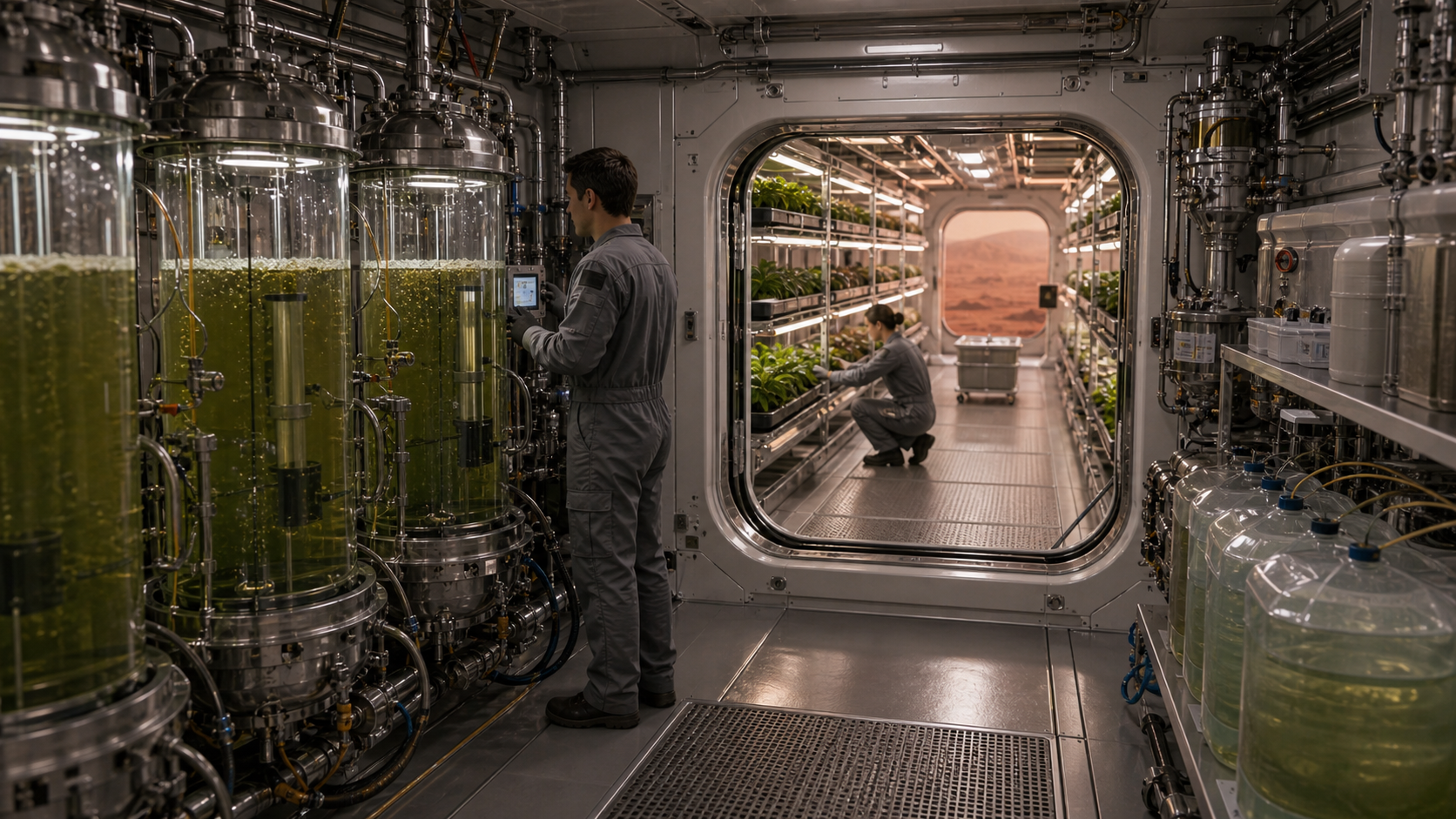
On Earth, farms rely on vast cycles: soil microbes, rain, rivers, fertilizer mines, atmosphere, sunlight, and global shipping. A Mars city has to miniaturize those cycles. Plant waste, inedible biomass, food scraps, wastewater, and possibly treated human waste contain carbon, nitrogen, phosphorus, potassium, and trace minerals. Throwing them away would slowly starve the farm.
ESA’s MELiSSA program is built around this closed-loop logic: recovering food, water, and oxygen from organic waste, carbon dioxide, and minerals using biological processes and light. A future Mars settlement would need something similar, though probably with many engineering layers for safety. Waste streams would be separated, treated, sterilized where needed, tested, and converted into nutrient solutions or growth media.
This is where farming merges with sanitation. A crop failure may start as a plumbing problem. A nutrient imbalance may start as a waste-processing problem. A food safety issue may start as a microbial monitoring failure. Mars agriculture will be a life-support discipline, not a separate rural activity.
What Can Still Go Wrong
The failure modes are sobering. A power outage can kill lights, pumps, fans, heaters, chillers, and sensors. A fungal outbreak can spread through dense crop racks. A contaminated nutrient loop can damage a harvest. A dust storm can reduce available solar power. A shortage of spare parts can turn a small broken pump into a food-security problem. A crop chosen for efficiency may fail because people simply do not want to eat enough of it.
That means Mars food planning must include redundancy. Multiple crop zones. Stored food reserves. Seed banks. Backup protein systems. Independent water and nutrient loops. Quarantine rooms for plants. Robotic monitoring. Manual emergency procedures. And enough dietary variety that people remain healthy in body and mind.
By 2300, a Mars city could feed itself, but only if it treats agriculture as infrastructure. The farm would be as important as the reactor, the water plant, and the habitat pressure shell. Mars settlers will not simply grow food. They will operate a living machine that keeps the city human.
Leave a Reply