
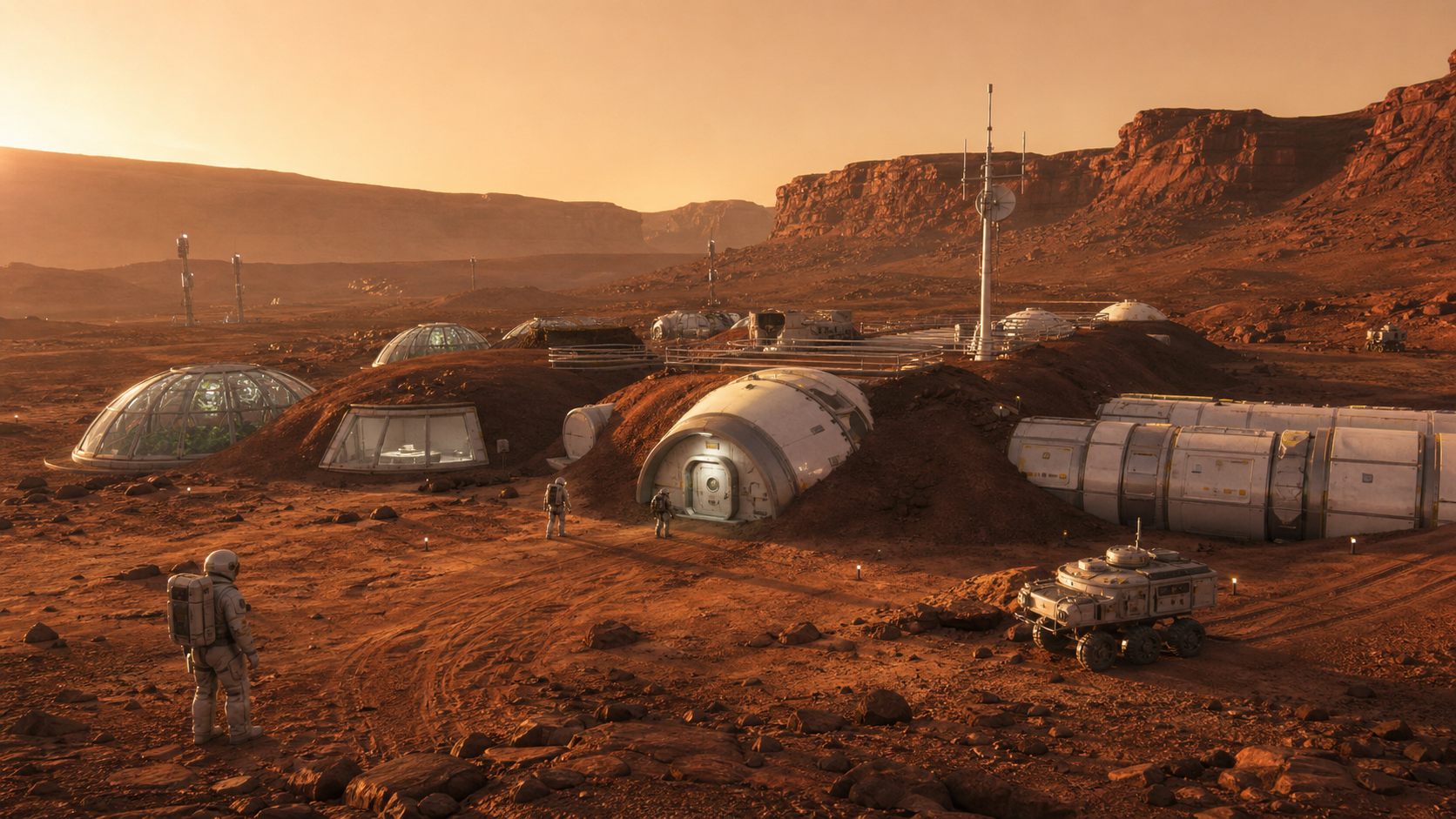
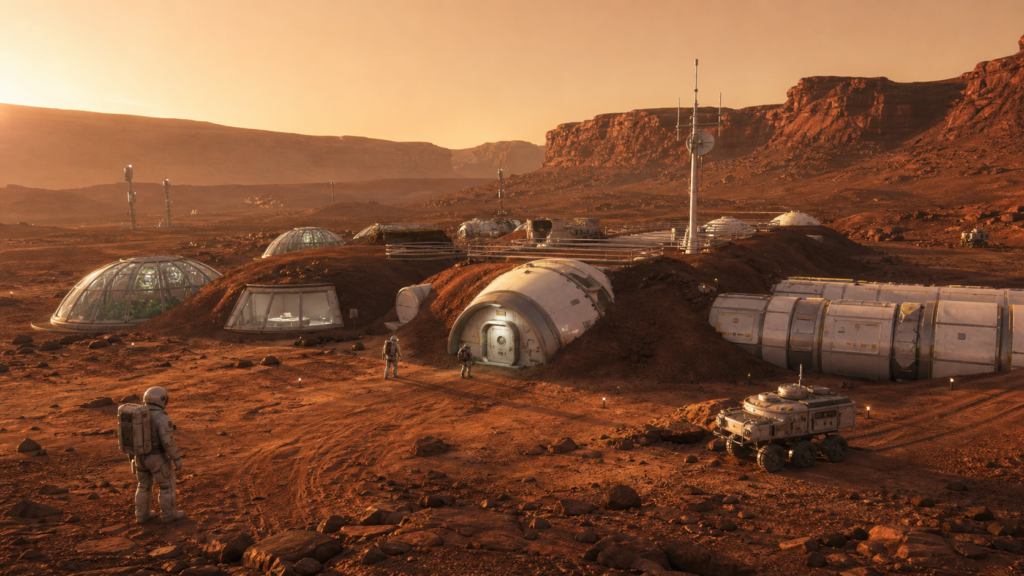
What if, by the year 2300, Mars is no longer just a distant world for astronauts and robotic probes, but a serious destination for human migration?
Not a short visit. Not a symbolic mission. A real migration would mean families, workers, scientists, engineers, doctors, children, hospitals, farms, schools, workshops, and a society that cannot depend on Earth to solve every crisis.
That future is far beyond today’s capability, but it is not pure fantasy. Many of the required technologies already exist in early form: reusable rockets, closed-loop life support, nuclear power, hydroponic farming, autonomous robots, 3D printing, advanced medicine, and artificial intelligence. The problem is not that these ideas are impossible. The problem is that they are not yet reliable, affordable, redundant, and integrated at the scale required for a permanent population on another planet.
A Mars migration would not be one invention. It would be a complete civilization system. By 2300, the question will not be whether humanity can send a crew to Mars. The deeper question will be whether we can build a durable human environment there.
Mars Migration Is More Than Space Travel
The first mistake is to think of Mars migration as mainly a transportation problem. Getting there is difficult, but arriving alive is only the beginning. Mars is hostile in almost every way that matters to human biology.
Its atmosphere is mostly carbon dioxide and far too thin to breathe. Surface pressure is less than one percent of Earth’s. Temperatures can fall far below freezing. Liquid water is not available on the open surface. Dust is fine, abrasive, and potentially harmful to machines and lungs. Radiation from space reaches the ground because Mars has no global magnetic field and only a thin atmospheric blanket.
Then there is the distance. Depending on orbital positions, Mars can be tens or hundreds of millions of kilometers away. Radio messages can take several minutes to more than twenty minutes one way. That delay changes everything. A doctor cannot consult Earth in real time during surgery. An engineer cannot wait for a remote expert while oxygen levels fall. A city cannot pause during a power failure and ask Earth what to do next.
A human city on Mars would have to be part spacecraft, part research station, part farm, part mine, part factory, and part society.
Transportation: Moving People and Cargo
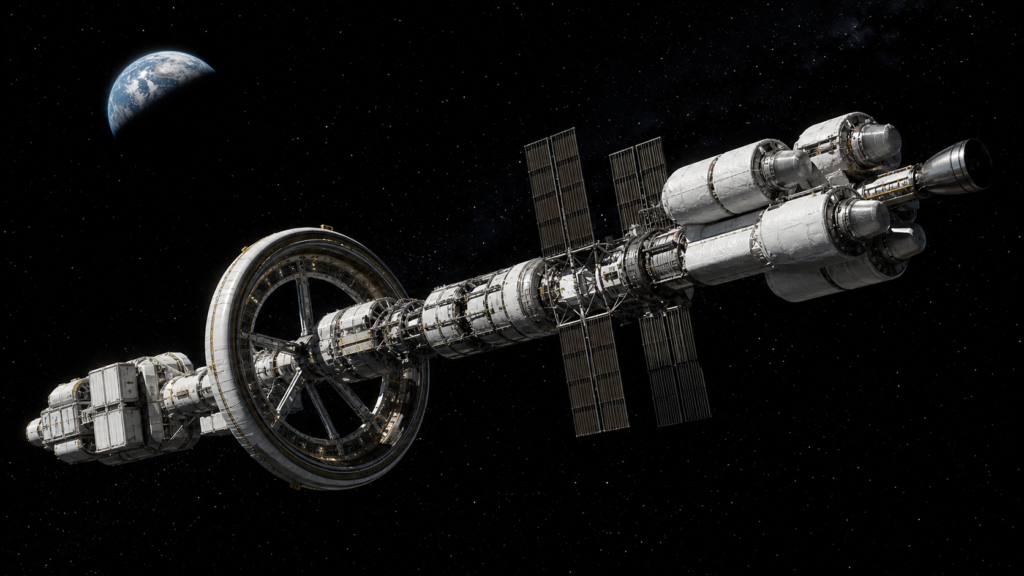
Before humans can migrate to Mars, space transportation must become routine enough to support logistics, not just exploration. A single successful mission is not enough. Migration requires a transportation network: launch vehicles, orbital refueling, cargo staging, passenger spacecraft, Mars landing systems, emergency return plans, and predictable supply cycles.
Reusable heavy-lift rockets are the starting point. They must move large amounts of hardware from Earth to orbit at costs far lower than traditional spaceflight. Orbital refueling may become essential. Passenger vehicles may need radiation shelters, medical areas, exercise systems, private sleeping space, and perhaps artificial gravity concepts such as rotating modules.
Landing is another major barrier. It is one thing to land a small robotic rover. It is another to land habitats, reactors, construction machines, water-processing equipment, and groups of people safely on the Martian surface. Mars has enough atmosphere to create drag and heating, but too little for parachutes alone to land heavy cargo.
Cargo would almost certainly go first. Robots and automated systems would need to deliver power units, shelter, communications, supplies, spare parts, and construction equipment before the first large human population arrives. A responsible Mars migration would not send people to an empty desert and hope they can build fast enough. It would send them to an already functioning base.
Shelter: Homes That Are Also Machines
On Earth, a house protects us from weather. On Mars, a house must protect people from death. A Mars habitat must hold air pressure, regulate temperature, block radiation, recycle water, remove carbon dioxide, prevent fire, and survive dust. It is closer to a submarine or space station than an ordinary building.
The first settlements may use prefabricated pressure modules brought from Earth. Later habitats could be covered with Martian soil, called regolith, to block radiation. Underground bases or lava tubes may offer better long-term protection. Another possibility is 3D-printing structures from local materials, with robots building thick protective shells before humans move in.
Architecture on Mars will not only be about beauty, though beauty will matter deeply. It will be about survival geometry. Where are the airlocks? How quickly can people reach storm shelters? Can one damaged module be sealed without sacrificing the entire habitat? How close should farms be to living areas?
A Mars city is not just built. It is engineered to stay alive, and every corridor, window, wall, and pressure door becomes part of a survival strategy.
Water, Air, and Food
The heart of Mars survival is the closed loop: use, recover, reuse. A settlement cannot treat water, air, and food as disposable supplies. Every kilogram launched from Earth is expensive, and every failed recycling system increases risk.
Water is the first priority. Mars has ice, especially near the poles and possibly underground in other regions. A settlement would need to mine, melt, purify, store, and recycle water with extreme efficiency. Wastewater, humidity from breath, and even urine would become valuable resources. Water would also be used to produce oxygen and hydrogen, support agriculture, cool equipment, and shield people from radiation.
Air is next. Oxygen could be produced by splitting water or by processing carbon dioxide from the Martian atmosphere. Carbon dioxide exhaled by humans would need to be removed from indoor air continuously. Nitrogen may become a surprisingly important resource because it helps create breathable air mixtures and supports plant growth. A Mars city must not simply make oxygen; it must manage an entire artificial atmosphere.
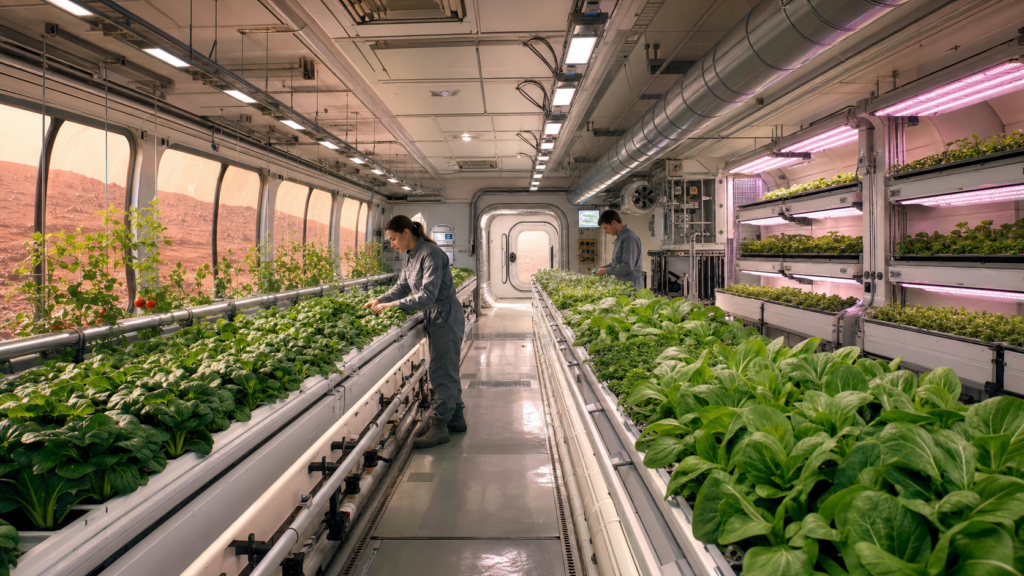
Food may be the most visible sign that Mars has become home. A permanent settlement cannot live forever on packaged meals from Earth. It would need hydroponic and aeroponic farms, algae systems, controlled lighting, nutrient recycling, seed banks, and possibly lab-grown protein. Plants would feed people, but they would also support mental health.
But farming on Mars is difficult. Martian soil contains toxic perchlorates and cannot be used like garden soil without treatment. Greenhouses must be pressurized, shielded, heated, and protected from system failures. By 2300, agriculture on Mars must be less like gardening and more like operating a biological factory.
Power and Industry
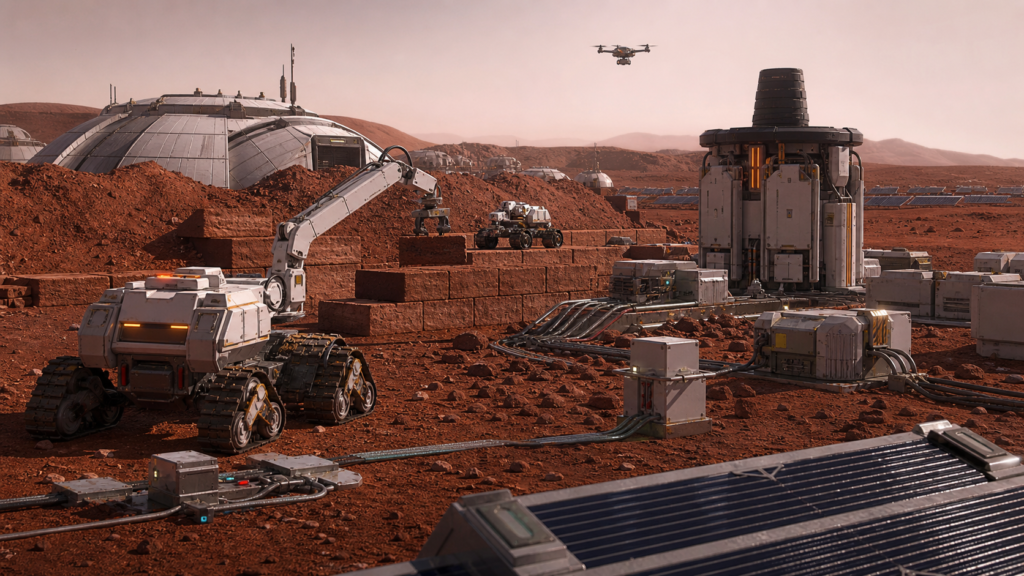
None of this works without power. Electricity is not a convenience on Mars. It is the difference between a living habitat and a sealed container in a frozen desert.
Solar energy will be useful, but Mars receives less sunlight than Earth, and dust can reduce output. Large battery systems would be needed for storage. For a settlement of thousands, nuclear power may be essential: compact reactors that provide steady electricity and heat through dust storms, winter cycles, and emergencies. The best Mars energy system may combine nuclear baseload, solar farms, batteries, fuel cells, and strict load management.
Power runs oxygen production, water recycling, farms, heaters, pumps, communications, medical systems, vehicles, mining equipment, and factories. If power drops, every other system begins to fail. The grid must isolate faults and keep critical life-support systems alive.
Industry is the next step. A Mars city that depends on Earth for every spare part is fragile. It must eventually make basic tools, pipes, seals, bricks, panels, wires, replacement components, and fuel. The more Mars can make from Mars, the less vulnerable it becomes.
Health, Gravity, and Radiation
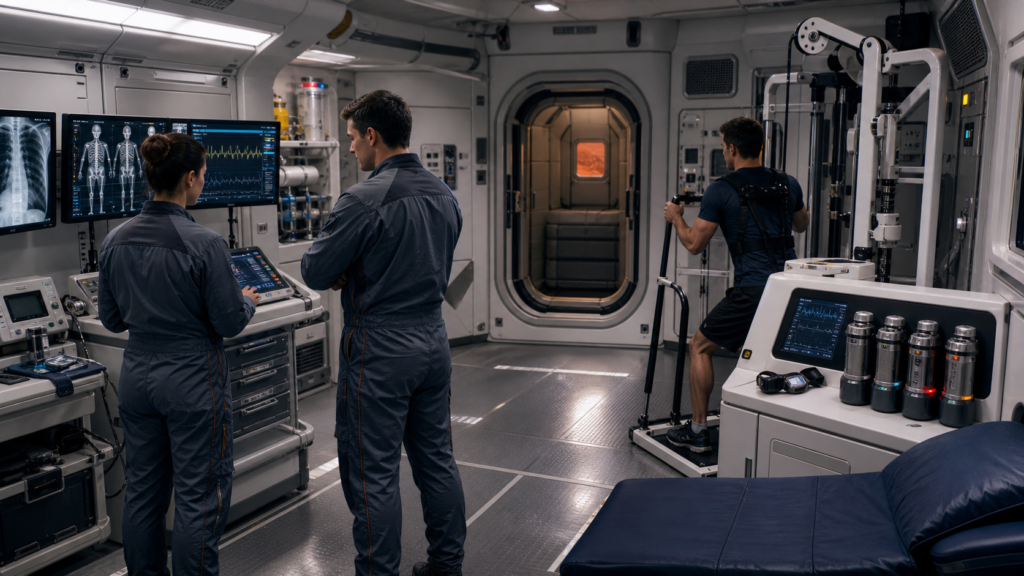
Even if the machines work, the human body may become the hardest engineering problem. Mars gravity is about 38 percent of Earth’s. That is more than the Moon, but we do not know whether it is enough for lifelong health. Long-term low gravity may affect bones, muscles, circulation, eyesight, pregnancy, and child development. Exercise systems will be essential, but they may not solve everything.
Radiation is another major threat. Galactic cosmic rays and solar particle events can damage cells and increase cancer risk. Settlements may need underground living spaces, storm shelters, water shielding, regolith shielding, and strict limits on outdoor work. For children and pregnant people, the unknowns become even more serious.
Mars medicine would have to be unusually self-reliant. Hospitals would need surgery, diagnostic imaging, dentistry, pharmaceutical storage or production, mental health care, rehabilitation, and emergency response. Medical teams would work with limited supplies and no instant evacuation option.
Robots, AI, and Readiness
Robots will likely arrive before the settlers. They can prepare landing zones, build roads, assemble habitats, bury structures under regolith, inspect solar fields, mine ice, maintain greenhouses, and repair equipment in dangerous conditions. AI systems could monitor air quality, power demand, crop health, water leaks, radiation alerts, and structural stress.
For Mars migration, automation is not a luxury. It is a survival strategy. Humans will be too few, too vulnerable, and too busy to do every task manually. A successful Mars city may begin as a robotic construction site long before it becomes a human home.
By 2300, technology readiness will mean more than proving something once in a laboratory. It will mean systems that can run for years, fail gracefully, be repaired locally, and work together. The oxygen plant, power grid, farm, hospital, and factory must function as one connected machine.
The Technology Stack of a Second Planet
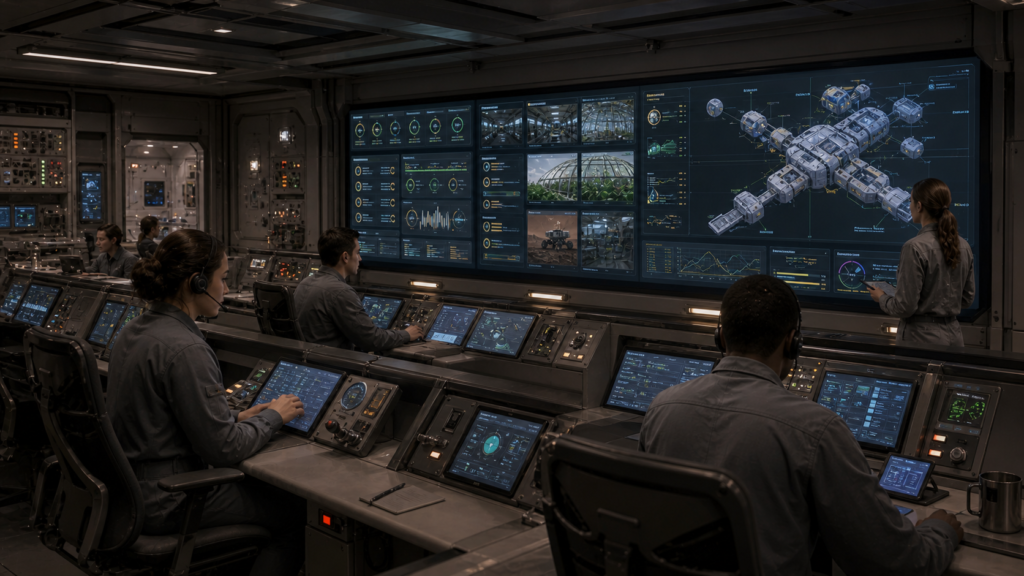
By 2300, Mars migration would require more than powerful rockets. It would require a complete technology stack for civilization: transportation, shelter, water, air, food, power, medicine, robotics, manufacturing, governance, education, and culture.
The central challenge is integration. Each system depends on the others. Farms need power and water. Power systems need maintenance. Maintenance needs tools. Tools need manufacturing. Manufacturing needs materials. People need health care, social order, privacy, purpose, and hope.
Before Mars can become a second home, it must become a reliable machine for keeping people alive. But if that machine ever becomes reliable enough, the meaning of Mars will change. It will no longer be only a destination for explorers. It could become the first place beyond Earth where human civilization learns how to survive by design.
And that is the real question this series will explore: not whether humans can visit Mars, but whether we can build a world there that ordinary people could actually live in.
References
- NASA Science: Mars Facts – atmosphere, surface conditions, and basic planetary data.
- NASA: Treasure Map for Water Ice on Mars – subsurface ice mapping relevant to future human landing sites.
- NASA Science: MOXIE – Mars oxygen production from atmospheric carbon dioxide.
- NASA: The Human Body in Space – health risks from radiation, altered gravity, isolation, and distance from Earth.
- NASA: Fission Surface Power – nuclear surface power concepts for future lunar and Martian missions.
Leave a Reply