
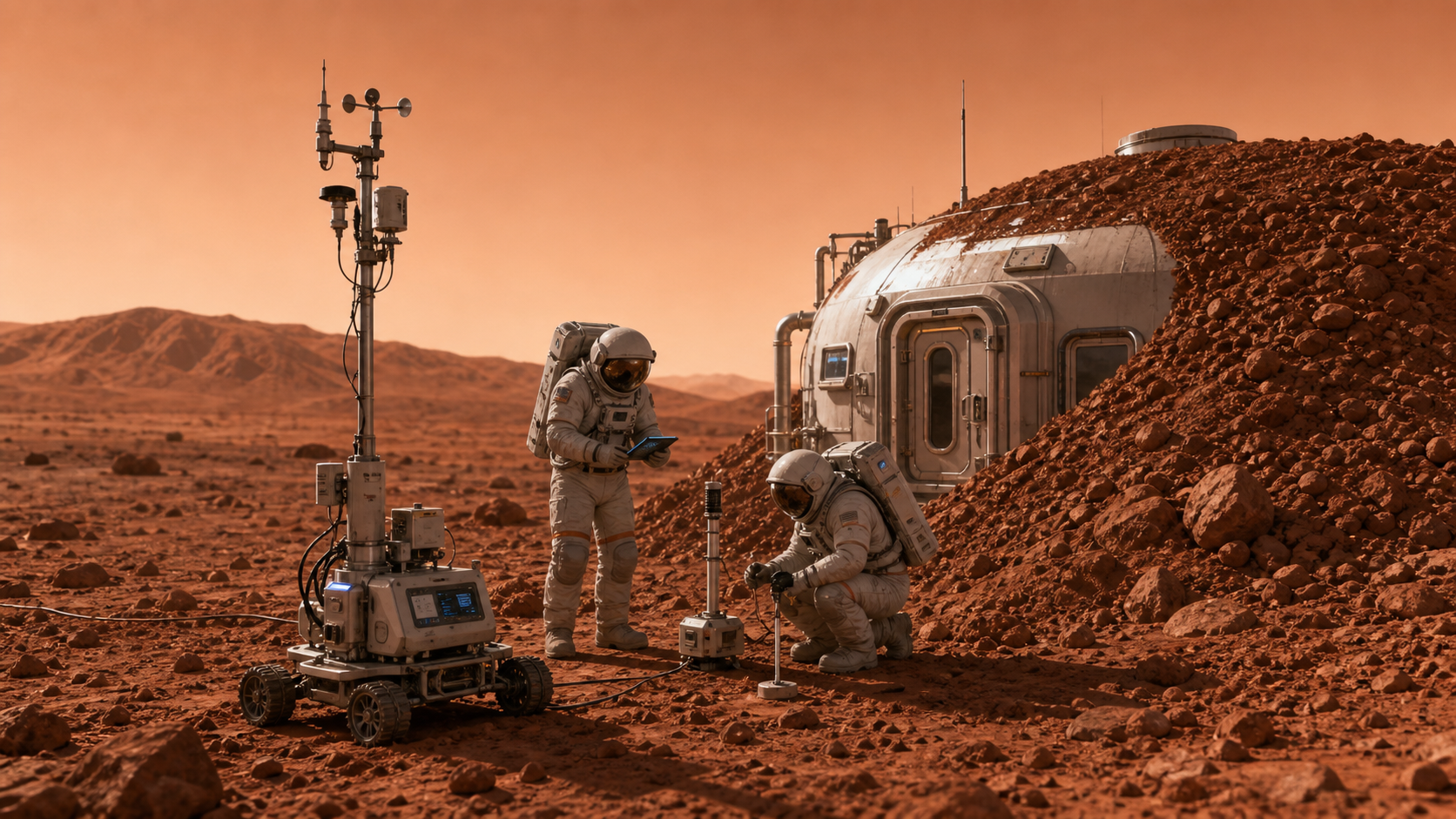
Radiation on Mars is invisible, silent, and patient. It does not look like a storm rolling over the horizon. It does not shake the habitat or crack the ground. Most days, it simply passes through the air, the walls, the spacesuit, and sometimes the body, adding a little more risk to a life already built around risk.
That is what makes it hard to talk about. Mars radiation is not an instant death sentence, and it is not something future settlers can ignore. It is a chronic environmental hazard, more like living in a city where the weather includes cancer risk, nervous-system uncertainty, electronics damage, emergency shelter drills, and strict outdoor work rules.
If humans want to build a real Mars city, radiation protection has to be treated as architecture, medicine, urban planning, weather forecasting, and operations discipline all at once.
Why Mars Is More Exposed Than Earth
Earth protects life with a thick atmosphere and a global magnetic field. Mars has a thin atmosphere and no Earth-like global magnetic shield. Some radiation is absorbed or scattered before it reaches the ground, but far less than on Earth. The surface is therefore exposed to a mix of galactic cosmic rays, solar energetic particles, and secondary particles produced when radiation strikes the atmosphere or soil.
Galactic cosmic rays are the steady background problem. They come from outside the solar system and include high-energy particles that are hard to block. Solar particle events are the emergency problem. A strong solar storm can raise radiation levels quickly, especially for people working outside or inside weakly shielded structures.
NASA’s Curiosity rover carried the Radiation Assessment Detector, or RAD, which measured radiation during the cruise to Mars and on the Martian surface. Those measurements helped move Mars radiation from speculation into engineering reality. The message is not that Mars is impossible. The message is that radiation has to be budgeted, measured, forecast, and shielded just like power, water, and air.
The Health Risk Is Cumulative
Radiation damages cells and DNA. The body repairs much of that damage, but not all of it. Over time, exposure can increase cancer risk and may affect the cardiovascular system, central nervous system, immune function, eyes, and other tissues. The exact risk depends on dose, particle type, dose rate, shielding, age, sex, genetics, mission duration, and medical history.
This makes Mars settlement different from short exploration. A six-month surface mission and a thirty-year life on Mars are not the same medical problem. A tourist visit, a scientific expedition, a construction tour, a pregnancy, and a childhood all require different standards. A mature Mars society would need radiation medicine, lifetime dose records, occupational exposure rules, pregnancy protection, cancer screening, and informed consent about risks that may not appear for decades.
Radiation also interacts with other stressors. Lower gravity, isolation, limited medical care, altered sleep, heavy workload, dust, and diet can all affect health. If a settler develops a heart problem or cognitive symptoms, doctors will need to consider the whole Mars environment, not radiation alone.
Solar Storms Turn Radiation Into Weather
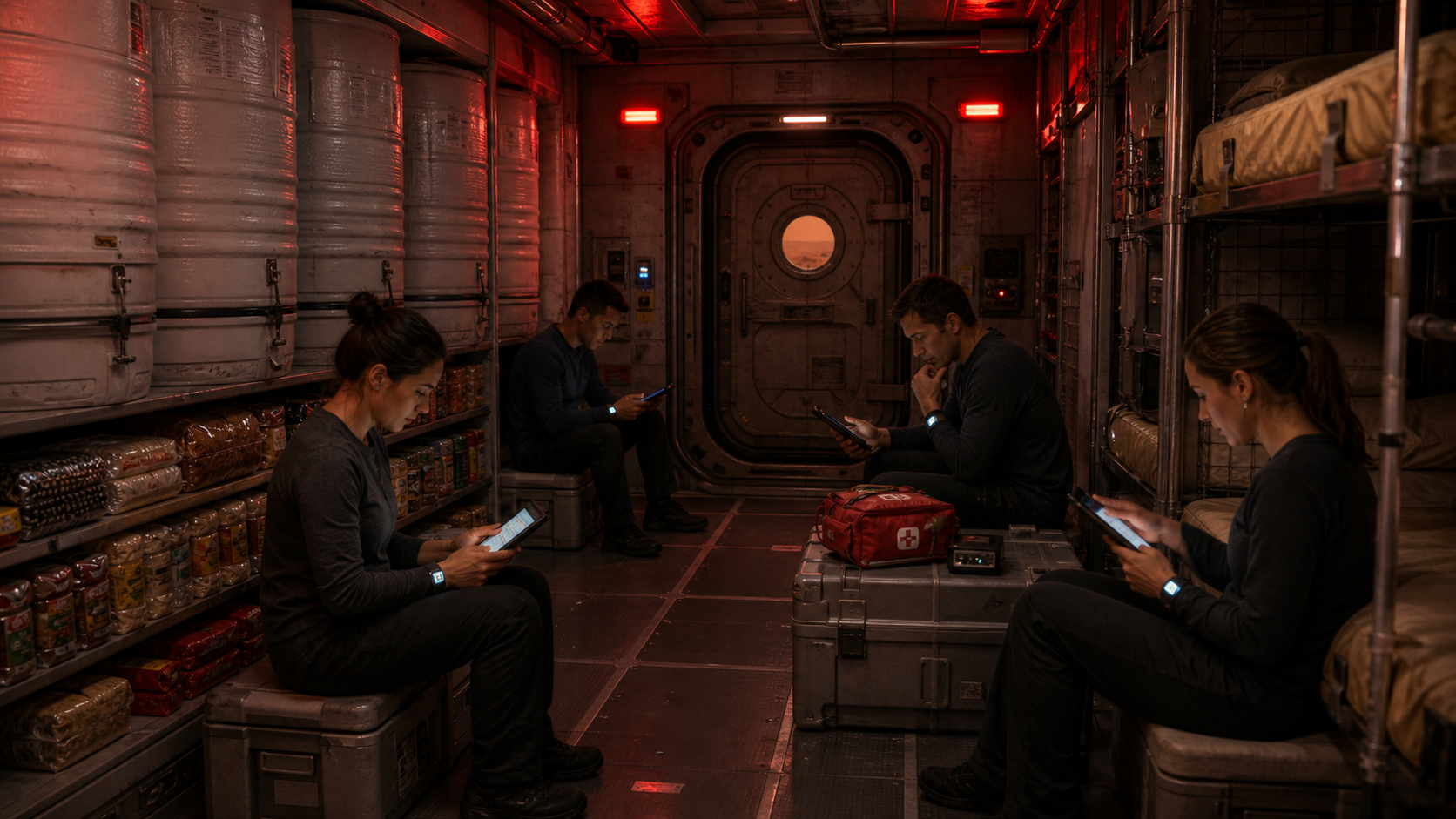
For everyday life, galactic cosmic rays set the background exposure. For emergencies, solar particle events set the rules. The Sun can eject bursts of energetic particles that may become dangerous for astronauts in space, on the Moon, or on Mars. A settlement therefore needs space-weather forecasting, alarms, procedures, and shelters.
A good storm shelter does not have to be beautiful. It has to be close. If a crew is spread across a habitat, greenhouse, rover garage, and outdoor worksite, everyone needs to know where to go and how fast. The shelter can use water tanks, food stores, waste tanks, polyethylene-rich materials, regolith, or dedicated shielding. Medical kits, communications, backup power, dosimeters, toilets, and enough room for a waiting crew matter too.
On Mars, radiation forecasts may become as normal as weather reports. Crews may delay outdoor work, return rovers early, or move children and medically vulnerable settlers into deeper shelter during elevated risk. A city that treats solar storms casually would be gambling with lives.
Shielding Becomes Architecture
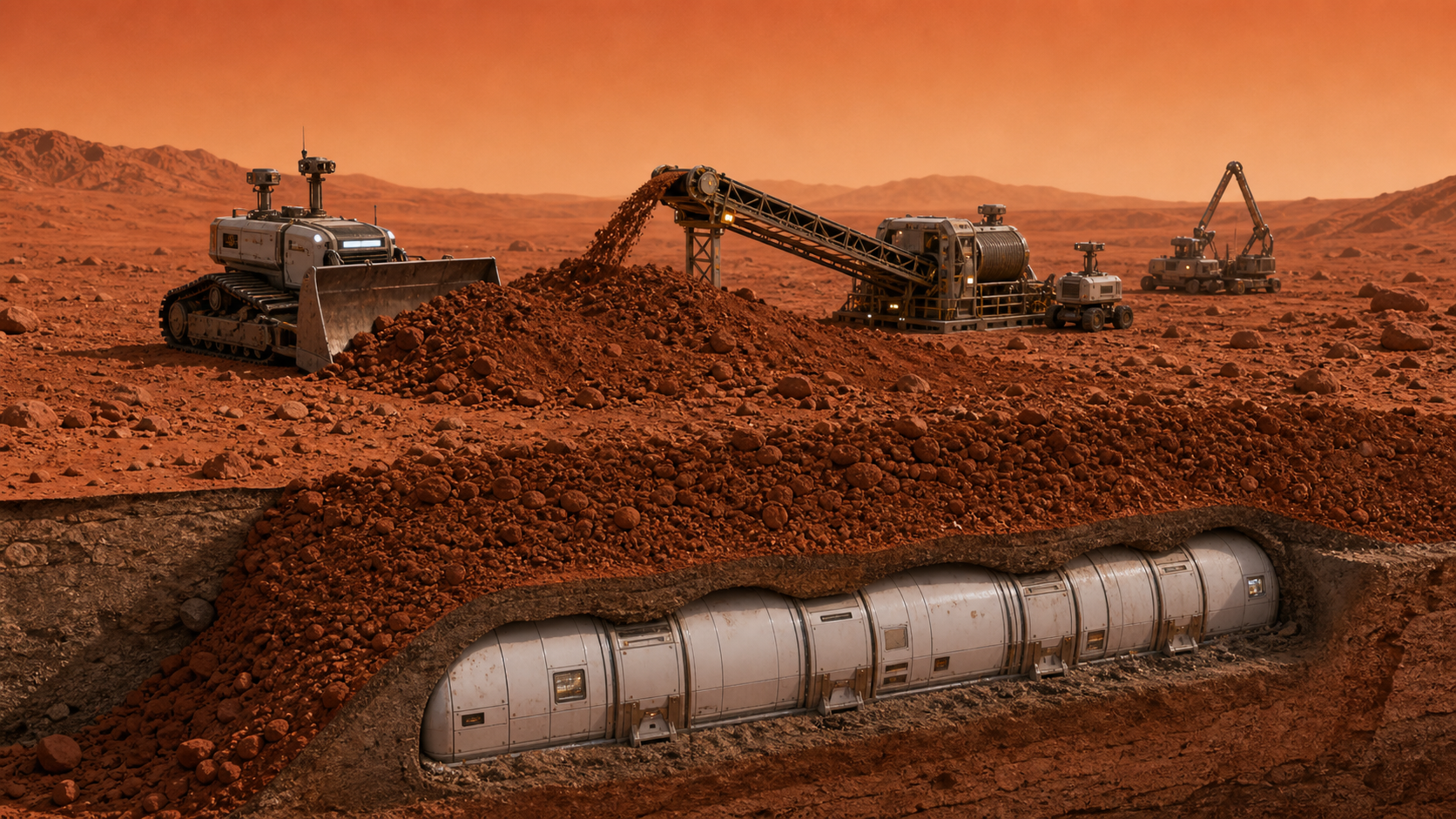
The best radiation shield is often mass, and Mars has plenty of mass in the form of regolith. Covering habitats with soil can reduce exposure, especially for long-duration living spaces. Water is also valuable because hydrogen-rich materials can help reduce some radiation risks, and water already has life-support value. Food, waste, fuel, and storage walls can all be placed strategically to add shielding where people spend the most time.
There is no free shield. Every layer adds construction work, structural load, inspection difficulty, dust handling, and repair complexity. Too little shielding raises lifetime dose. Too much shielding in the wrong way can make habitats hard to maintain. The engineering answer will likely be layered and selective: heavy shielding around sleeping rooms, medical rooms, storm shelters, nurseries, and control centers; lighter protection around short-duration work areas.
Robots matter here. Before large crews arrive, autonomous equipment can move regolith, build berms, cover modules, inspect buried utilities, and verify that emergency routes remain open. Radiation protection is not only a material choice. It is a construction plan.
Underground Living Is Powerful but Not Simple
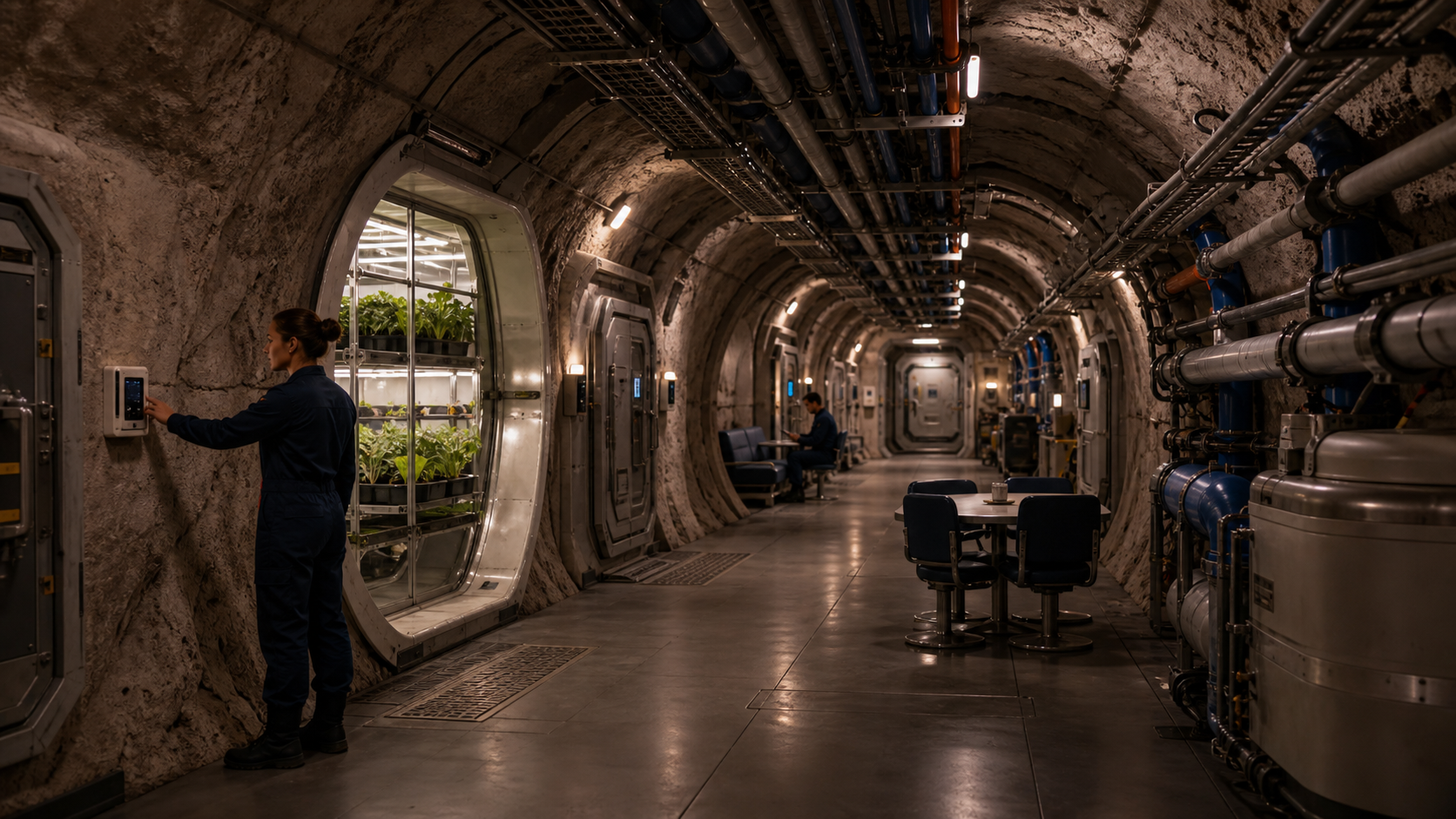
One obvious answer is to live underground. Even a few meters of overburden can make a major difference, and natural lava tubes, excavated tunnels, covered trenches, and buried modules all appear in Mars settlement concepts. Underground spaces also offer thermal stability and protection from micrometeoroids and dust storms.
But underground living creates its own hazards. Geology must be understood. Tunnels must not collapse. Dust and loose material must be controlled. Pressure doors, ventilation, power, fire safety, emergency exits, drainage, communications, and psychological design all become critical. A cave that blocks radiation but traps people is not a safe home.
The likely future is hybrid. Mars cities may keep landing zones, antennas, solar arrays, rover yards, and some industrial work on the surface, while placing bedrooms, clinics, storm shelters, nurseries, water reserves, and long-stay habitats below or under thick cover. The more time people spend in a space, the better shielded it should be.
Outdoor Work Will Need Dose Limits

A Mars city cannot eliminate outdoor work. People will still inspect equipment, collect samples, repair rovers, maintain power systems, build structures, and respond to emergencies. But outdoor time will be managed. Each worker may carry dosimeters. Rovers may include shielded cabins and emergency supplies. Work plans may include maximum exposure windows, return routes, and storm shelter triggers.
This will shape labor and society. Some jobs may have higher exposure than others, just as some Earth jobs involve radiation, chemicals, or industrial hazards. A fair Mars society would need transparent rules: who takes dose, who decides, how exposure is recorded, what medical follow-up is required, and when someone must be reassigned for health reasons.
Radiation will also shape childhood. Children should not spend their lives accumulating avoidable exposure just because adults want surface views. Schools, play spaces, clinics, and homes would likely be among the most protected environments in the city.
What Remains Unsolved
The biggest uncertainty is not whether radiation exists. It is how to manage a lifetime of it across a diverse population. Current astronaut standards are designed for limited careers, not whole societies. A city needs rules for adults, children, pregnant people, older settlers, patients, workers, visitors, and people with different medical vulnerabilities.
Better shielding materials, better radiation biology, better forecasting, better underground construction, and better medical screening will all help. So will conservative design. The safest Mars city is not the one with the largest glass dome. It is the one where people spend most of their lives behind quiet, boring, well-measured shielding.
Radiation does not make Mars impossible. It makes Mars honest. A settlement that survives for generations will not defeat radiation with optimism. It will measure it, plan around it, hide from it when necessary, and build homes where the most dangerous part of the sky is kept outside.
Leave a Reply