
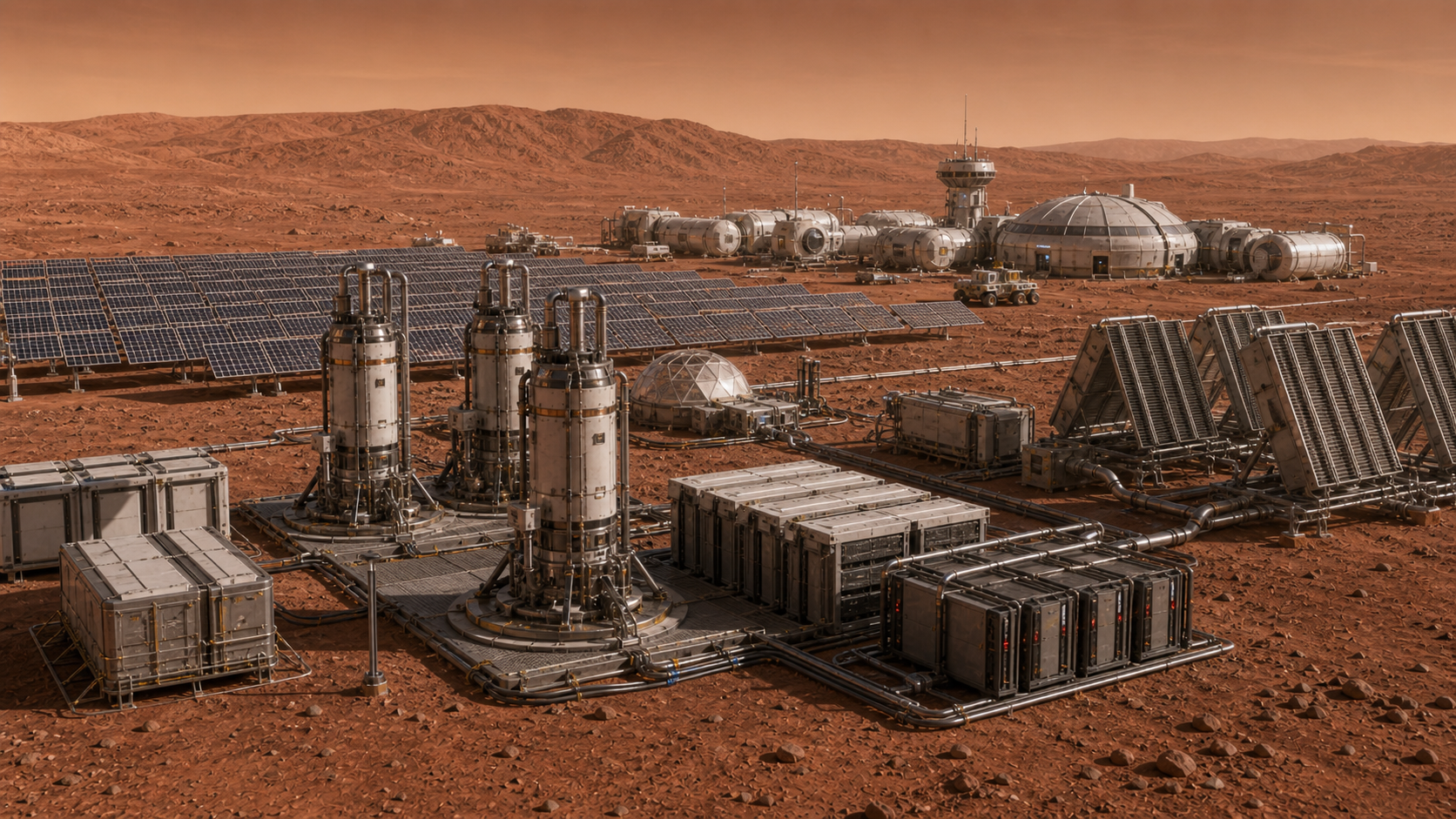
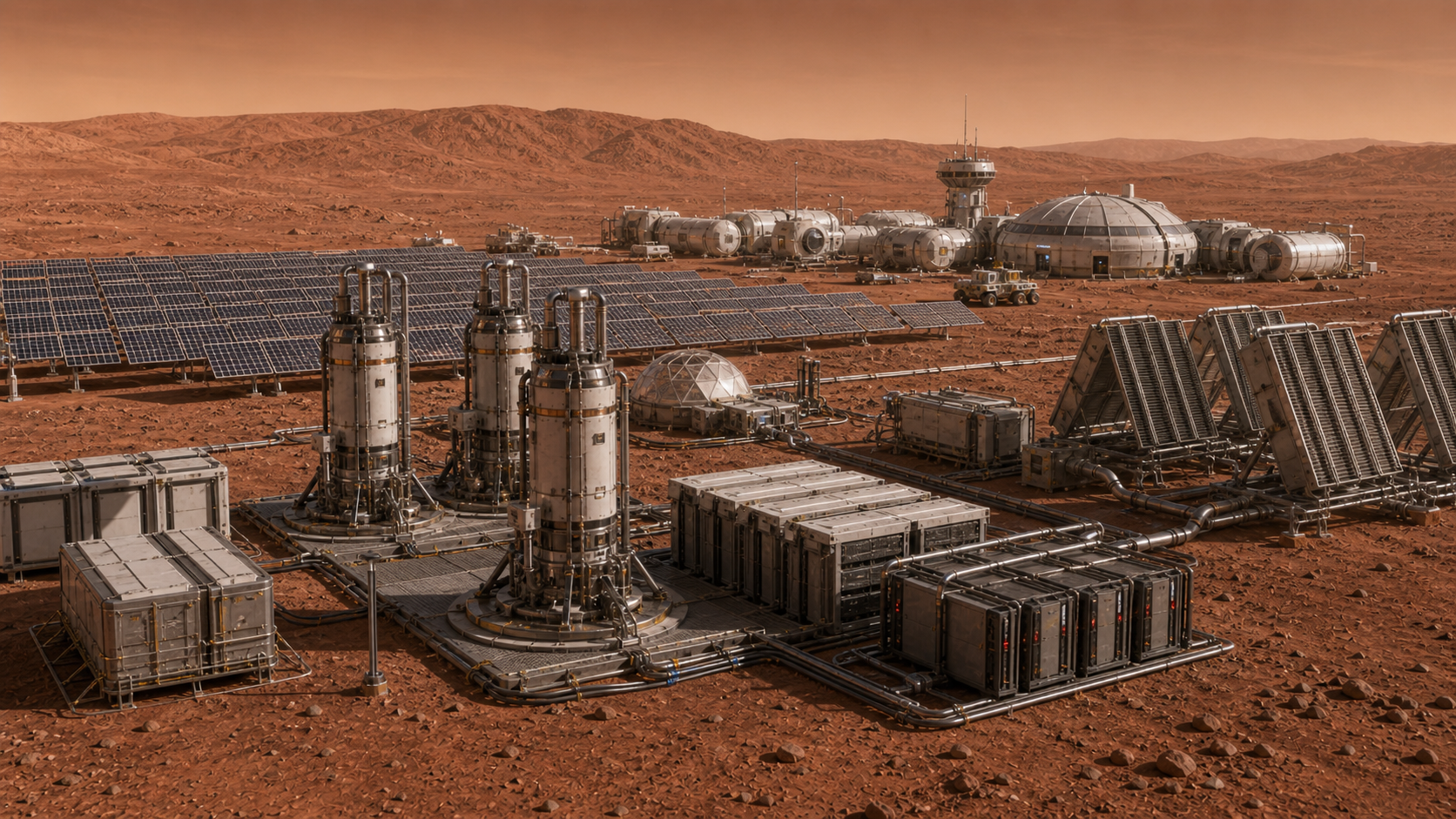
A Mars city lives or dies by its power system. Air, water, heat, food, medicine, communications, mining, construction, computers, pumps, valves, lights, and emergency shelters all depend on electricity. If power fails for long enough, a settlement does not merely become uncomfortable. It starts to lose pressure, temperature, water, crops, and time.
On Earth, power failures are usually local events inside a vast grid. On Mars, the grid is the settlement. There is no neighboring city to borrow electricity from, no regional repair crew, no fuel truck arriving tomorrow, and no easy evacuation if the system collapses. A serious Mars settlement therefore needs a power architecture, not just a power source.
The most realistic answer is not nuclear or solar alone. It is a layered system: nuclear surface power for reliable baseload, solar arrays for scalable daytime generation, batteries and other storage for transients, microgrids to isolate faults, thermal systems to move heat, and emergency reserves that keep life support alive during dust storms, equipment failures, or maintenance shutdowns.
Power Is Life Support
For a Mars settlement, electricity is not only an industrial convenience. It is part of the habitat pressure shell. Fans move air through carbon dioxide scrubbers. Pumps circulate water through purification systems. Heaters keep pipes and tanks from freezing. Greenhouses use lights, fans, humidity control, and nutrient pumps. Medical systems need refrigeration, sterilization, monitoring, imaging, and communications. Mining and manufacturing need drills, crushers, furnaces, rovers, robots, and control computers.
That means settlement power has to be judged by more than average output. It needs reliability, maintainability, safety, repairability, predictable fuel or input supply, and graceful failure. A power plant that works perfectly for 95 percent of the year but fails during a dust storm is not enough. A solar farm that produces excellent daytime power but cannot keep the water plant warm overnight is not enough. A reactor that produces steady electricity but cannot be repaired by local crews is also a risk.
By 2300, the mature answer may look like a city-scale microgrid: many generation nodes, multiple storage layers, automated switching, protected cable routes, local repair shops, spare parts, and enough redundancy that no single failure can freeze the settlement.
Why Nuclear Power Is Hard to Avoid
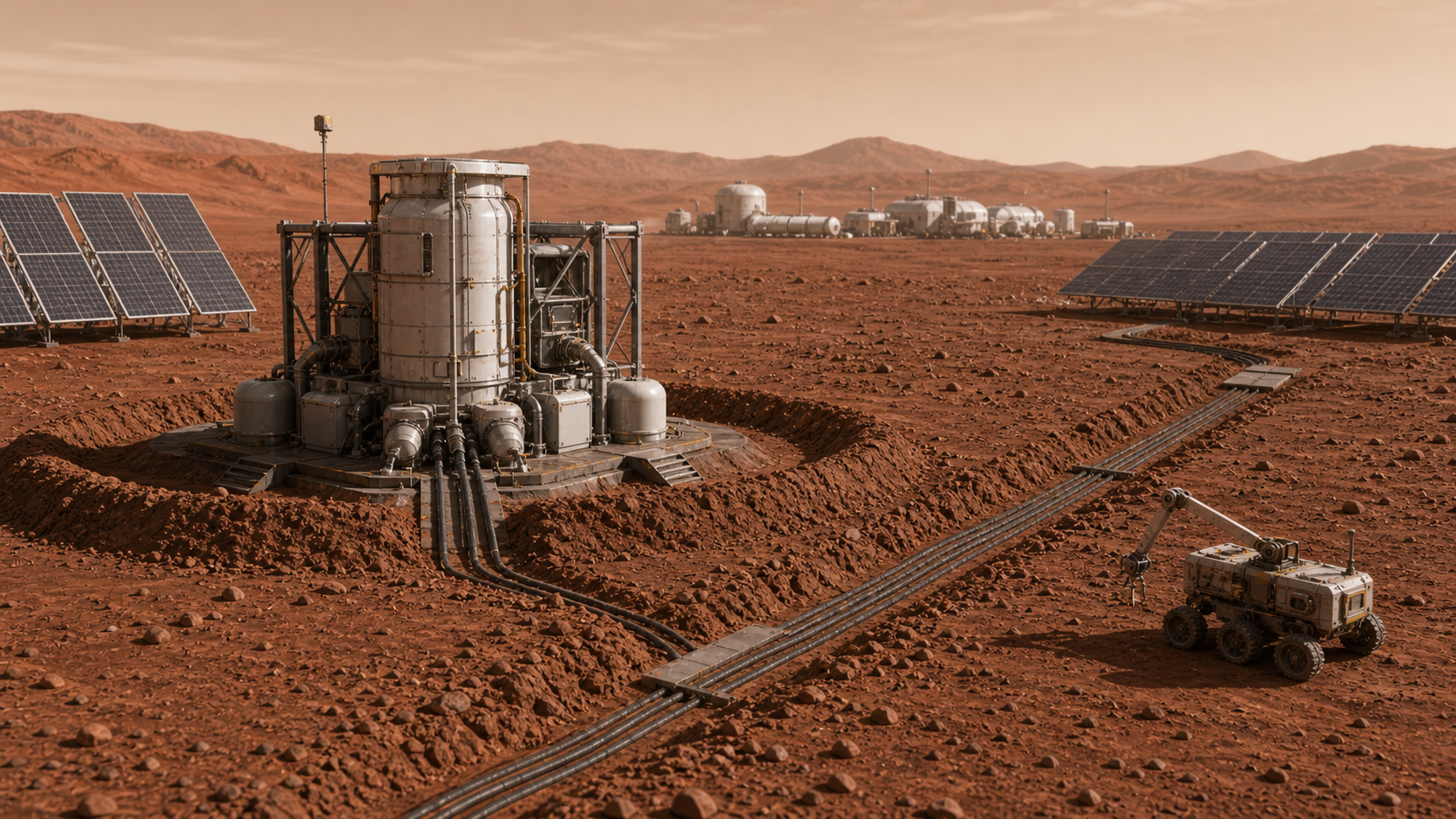
Nuclear surface power is attractive on Mars for one simple reason: it does not care whether the Sun is shining. NASA and the U.S. Department of Energy have studied fission surface power systems for the Moon and Mars, including compact reactors in the tens-of-kilowatts class that could operate continuously for years. NASA’s Kilopower project demonstrated a small fission power concept using a uranium core, heat pipes, and Stirling conversion to produce electricity.
For a settlement, that kind of steady supply matters. Life support needs power at night. Greenhouses need controlled temperatures through seasonal changes. Water extraction and purification may run best as continuous industrial processes. Communications, medical systems, server rooms, and thermal control cannot simply pause whenever dust reduces sunlight.
Nuclear power also has design complications. Reactors must be transported safely, landed safely, deployed away from habitats, shielded or separated, cooled, monitored, and eventually repaired or replaced. Waste heat is not a detail; it has to go somewhere. Crews need procedures for startup, shutdown, fault isolation, and emergency response. A Mars city would not put its reactor casually beside the greenhouse. It would treat nuclear power as a protected industrial zone connected to the settlement by robust cable corridors.
Solar Power Still Matters
Solar power is not disqualified by Mars’s distance from the Sun. Mars receives less sunlight than Earth, and dust can reduce output, but solar arrays are modular, scalable, and relatively simple compared with nuclear reactors. They can be deployed in fields, mounted on habitats, placed on mobile assets, or expanded as a settlement grows.
The challenge is variability. Day-night cycles are obvious. Seasons matter. Latitude matters. Dust storms can reduce sunlight dramatically, and ordinary dust accumulation slowly degrades panel output. NASA’s Mars history provides reminders: solar-powered missions such as Opportunity and InSight were deeply affected by dust, while nuclear-powered systems using radioisotope generators have operated through night and winter with far less dependence on sunlight.
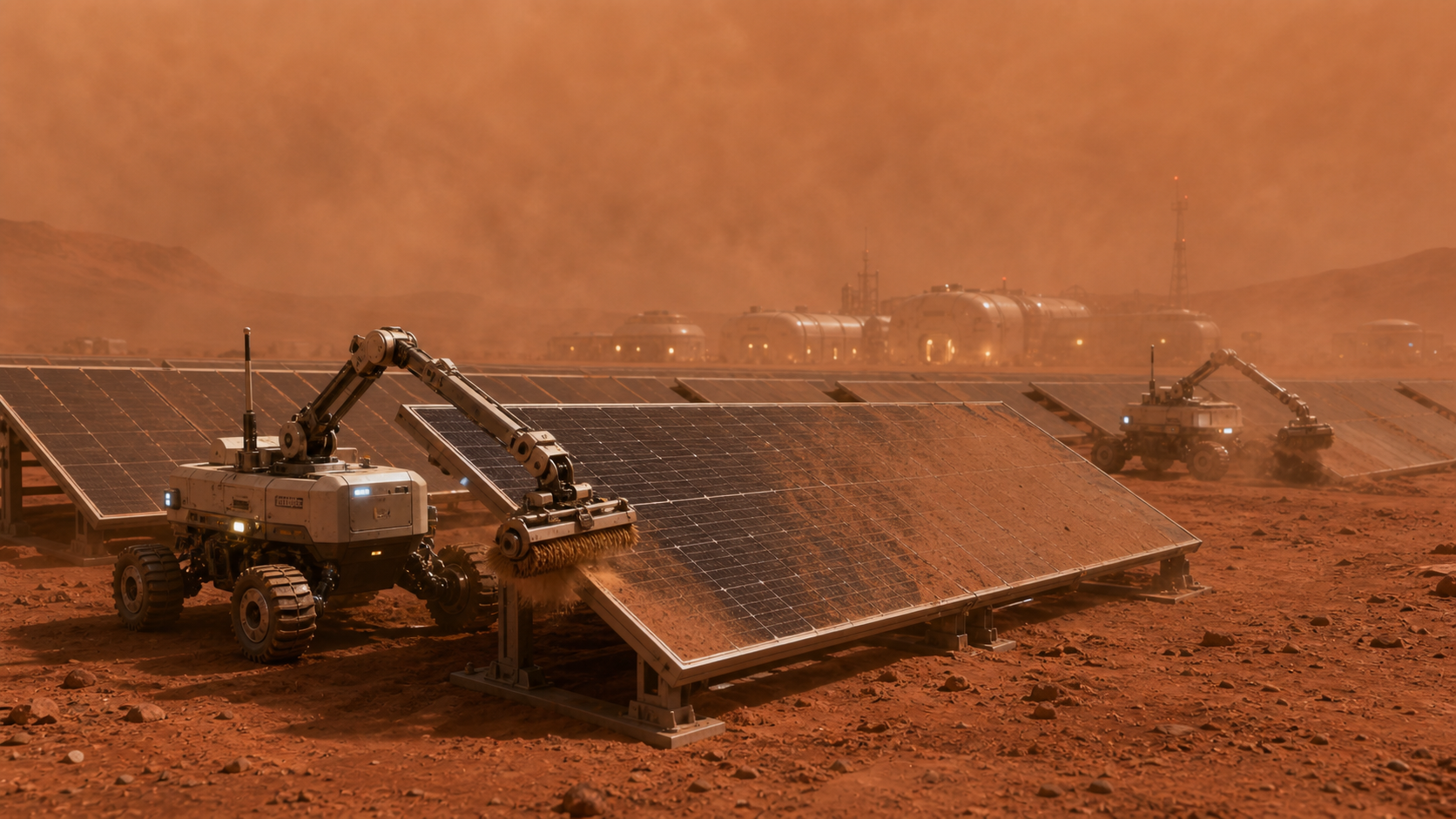
For a settlement, solar farms would need maintenance robots, dust-resistant panel designs, cleaning systems, spare panels, cable redundancy, and careful siting. They would be valuable for daytime industrial loads, electrolysis, greenhouse lighting support, battery charging, and noncritical processing. But a serious settlement would not design its life support around an assumption that the sky will remain clear.
Storage Is the Bridge Between Sources and Survival
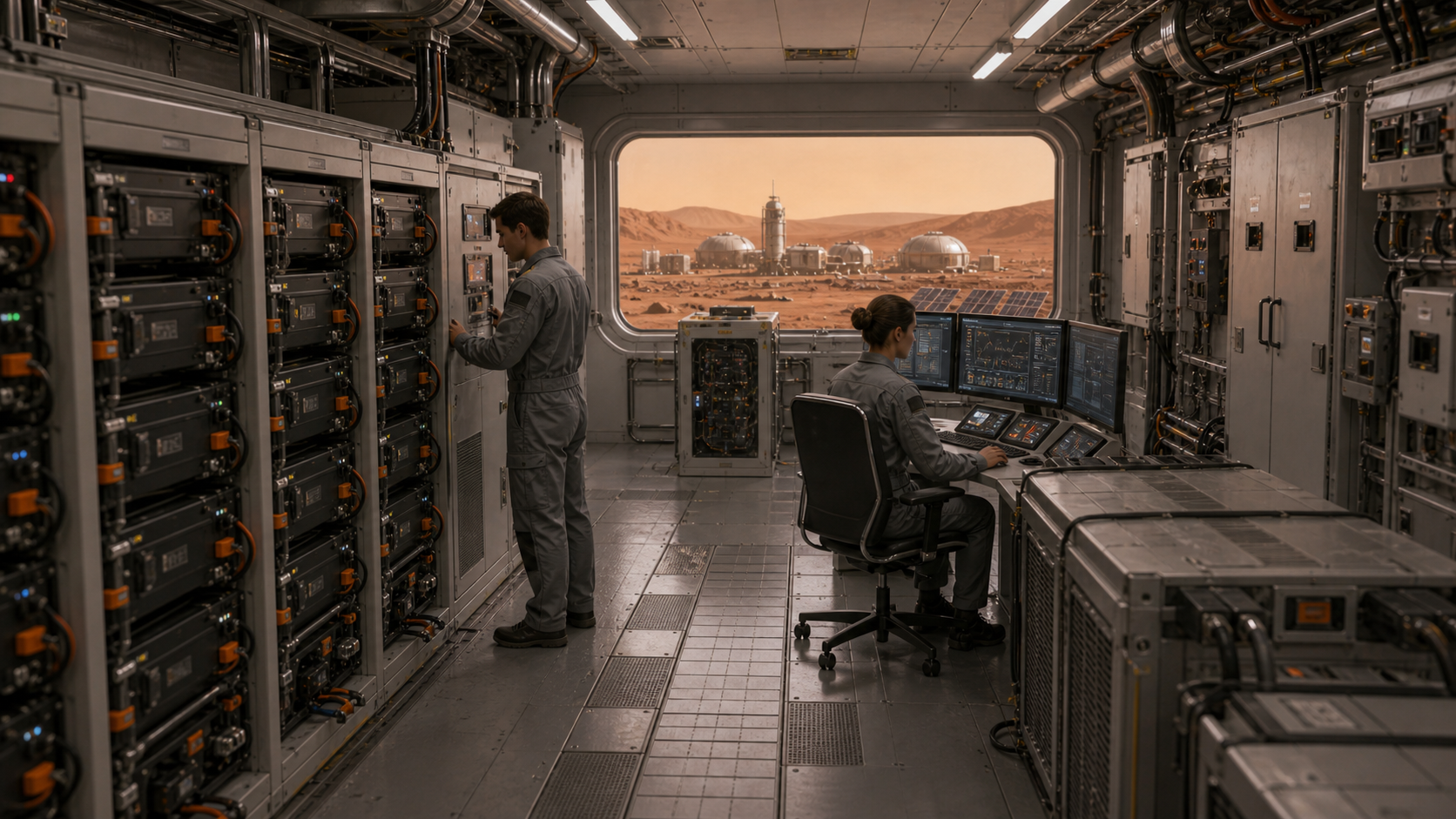
Power storage on Mars is not optional. Batteries can smooth short-term changes, support nighttime loads, bridge reactor maintenance, absorb solar peaks, and keep critical systems alive while backup generators start. Other storage methods may also matter: regenerative fuel cells, compressed gases, thermal storage, flywheels, or chemical fuels made from local resources.
The key is matching storage to time scale. Seconds and minutes need power electronics and batteries. Hours may need larger battery banks or fuel cells. Days of dust storm resilience may require a combination of nuclear baseload, stored chemical energy, load shedding, and deliberate rationing. A city cannot afford to discover during an emergency that all storage was designed for the wrong duration.
Microgrids make this survivable. Instead of one fragile network, a settlement would divide into protected zones: habitats, water plant, medical center, greenhouses, communications, industrial yard, landing zone, and emergency shelters. If one cable trench fails or one battery room overheats, automated switches can isolate the problem and keep the rest alive. The goal is not only to deliver power, but to prevent failure from spreading.
Heat Is Part of the Power Problem
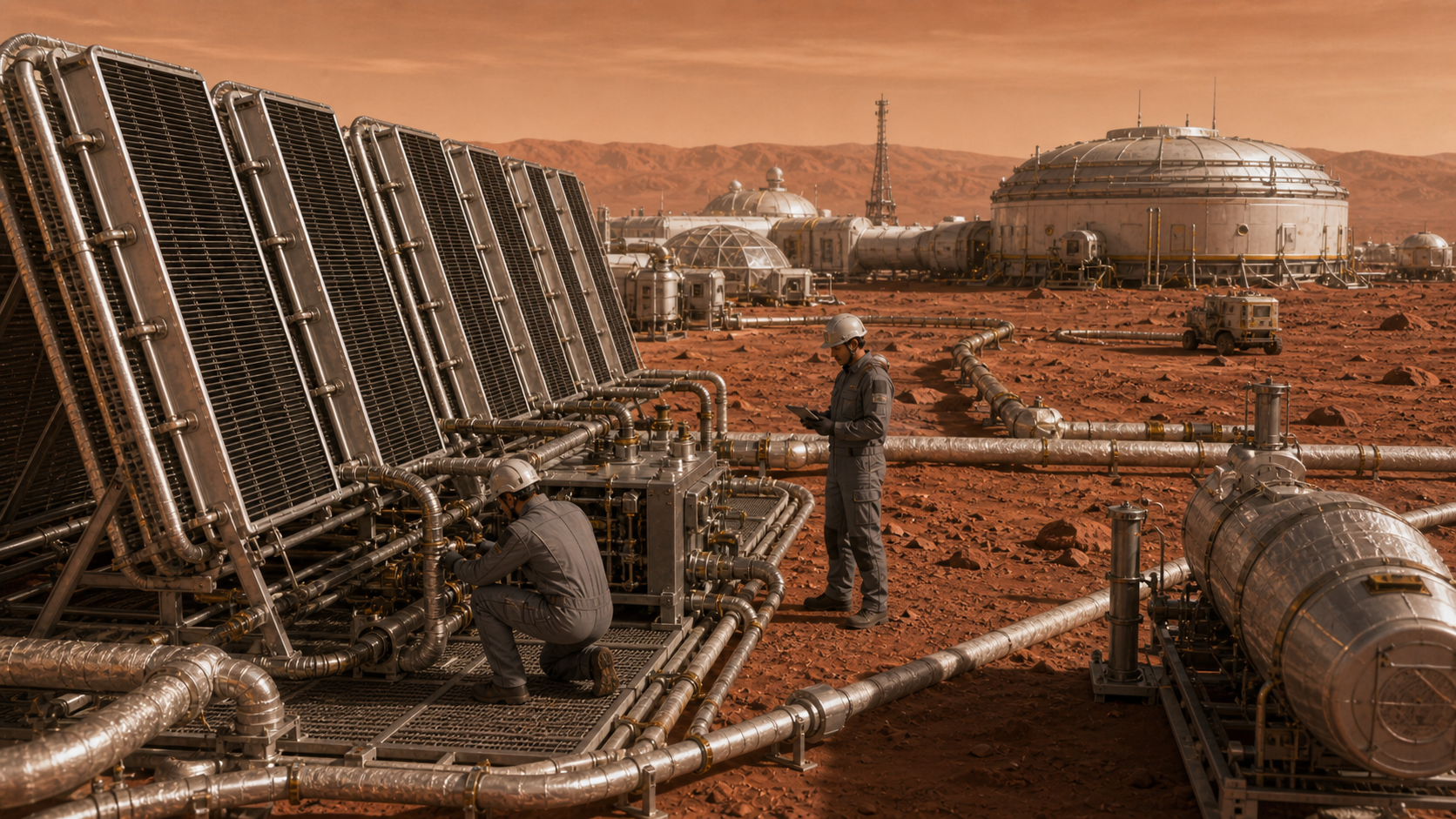
On Mars, energy is not only electricity. It is also heat. Habitats need warmth. Water pipes must not freeze. Batteries have temperature limits. Greenhouses need stable conditions. Reactors and power electronics produce waste heat that must be moved and rejected. At night, thermal losses can threaten equipment; during heavy industrial operations, too much waste heat can become its own problem.
This means a Mars settlement needs thermal architecture: insulation, heat exchangers, radiator panels, thermal storage tanks, buried pipes, heat pumps, and smart control systems. Waste heat from reactors or industrial systems might warm habitats, melt ice, or support greenhouses. But using heat well requires planning. A pipe route that saves energy in normal operations may become a vulnerability if it freezes, leaks, or cannot be isolated.
Thermal management also affects where systems are placed. Reactors may need separation for safety but still must deliver useful energy. Solar farms need exposure. Batteries may prefer protected, temperature-controlled rooms. Greenhouses need light and heat but also shielding. A settlement map is partly an energy map.
Dust Storms Are a Design Requirement
Mars dust storms are not surprise plot devices. They are environmental conditions that engineers must assume. Regional and global dust events can reduce sunlight, coat surfaces, change thermal behavior, and complicate outdoor maintenance. NASA’s experience with solar-powered landers and rovers shows how dust can turn energy into a mission-ending constraint.
A settlement should be able to enter a storm mode: reduce nonessential industrial loads, prioritize life support, keep water and medical systems warm, protect greenhouses, delay energy-intensive manufacturing, and use storage carefully. Solar cleaning robots may work before or after the worst conditions, but crews should not depend on people walking outside in dangerous weather to rescue the grid.
This is where nuclear baseload, storage, and microgrids reinforce each other. Nuclear power reduces dependence on the sky. Storage handles transitions. Microgrids isolate failures. Solar contributes when available. Together, they make the settlement less brittle.
What Remains Unsolved
The hardest unsolved issue is not whether electricity can be generated on Mars. It can. The problem is building a power system that can grow for centuries without constant rescue from Earth.
A settlement needs spare parts, local manufacturing, trained power engineers, radiation and dust protection, repair robots, software security, fuel logistics, battery recycling, and governance rules for who gets power during emergencies. It must decide which loads are sacred: oxygen, water, pressure, medical systems, food, communications. It must also decide which industrial dreams can wait when the grid is stressed.
By 2300, a Mars city may have reactors, solar farms, buried cables, thermal reservoirs, battery caverns, fuel-cell plants, and automated grid controllers. But the principle will remain simple: power is survival. The settlement that masters energy will be able to mine water, grow food, build homes, treat illness, and expand. The settlement that treats power as an afterthought will always be one fault away from emergency.
Leave a Reply