
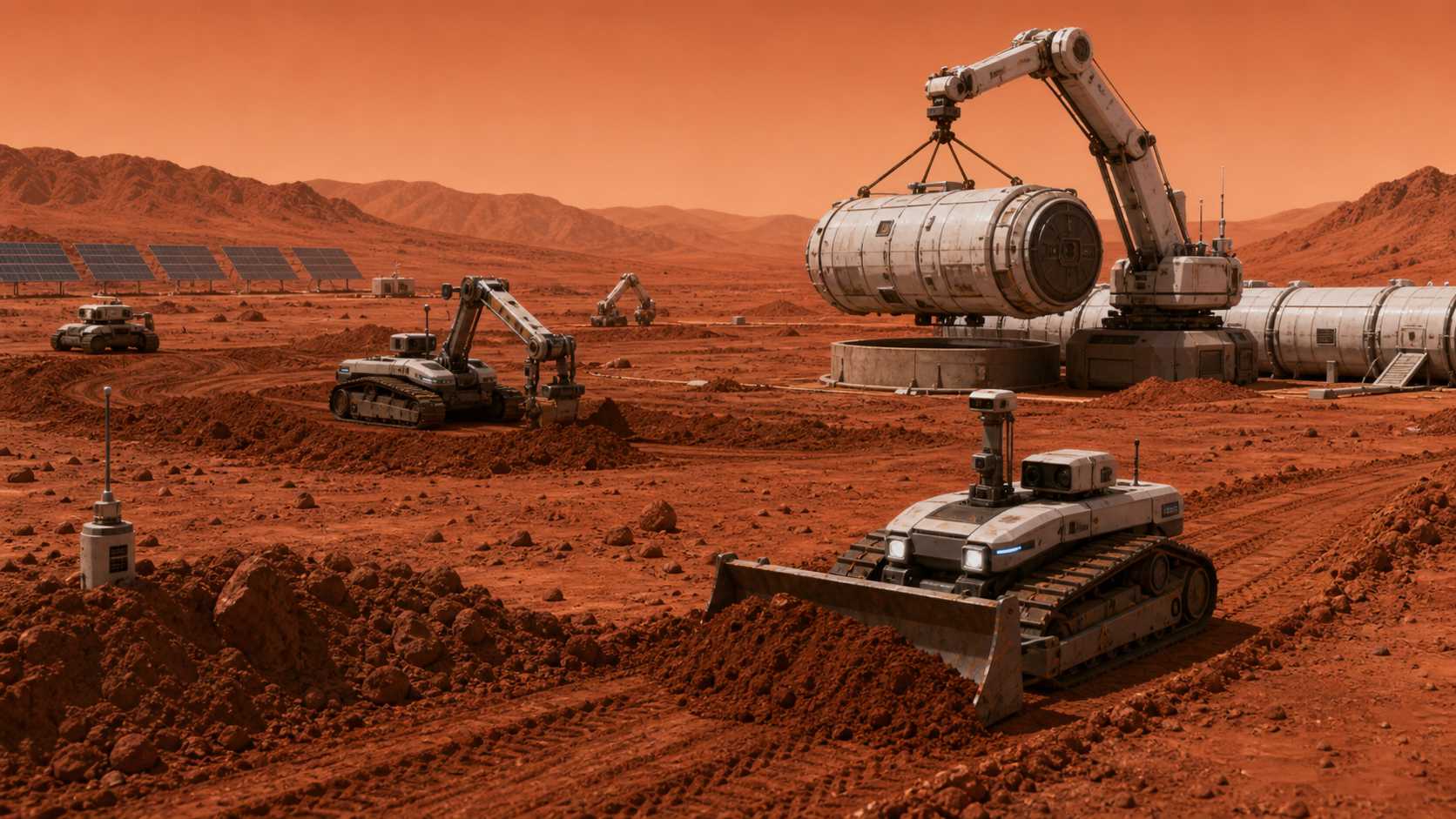
The first city on Mars should not begin with astronauts stepping onto an empty plain and wondering where to sleep. It should begin years earlier, with machines landing in waves, waking up, checking themselves, moving dirt, connecting power, drilling for water, building shields, growing test crops, and sending boring status reports home.
Robots are not a futuristic luxury for Mars. They are the bridge between exploration and settlement. If humans arrive before the basics are proven, every problem becomes a crew emergency. If robots arrive first, many failures can happen while nobody is standing under the crane, breathing the air, or depending on that greenhouse for dinner.
For a serious Mars migration program, the question is not whether robots should help. The question is how much work they must complete before the first large crews leave Earth.
Cargo-First Means Risk-First
A Mars settlement needs mass: habitats, pressure vessels, airlocks, reactors or solar fields, batteries, rovers, drills, spare parts, medical equipment, food systems, water tanks, communications, landing pads, construction tools, and shielding. Sending all of that with the first crew would be dangerous and inefficient. The safer pattern is cargo-first deployment.
But cargo alone is not enough. A habitat sitting untouched on Mars is not yet a settlement. It must be inspected after landing, leveled, connected, pressure tested, powered, shielded, and protected from dust. Solar panels must be deployed and cleaned. Cables must be routed. Tanks must be checked for leaks. Landing sites must be surveyed for hazards. The machines that do this work become the first construction crew.
This changes mission design. Instead of asking how many astronauts can work outside in a day, planners ask how much the robotic system can finish before the crew arrives. The human mission becomes a handover, not a rescue operation.
Robots Must Move Dirt
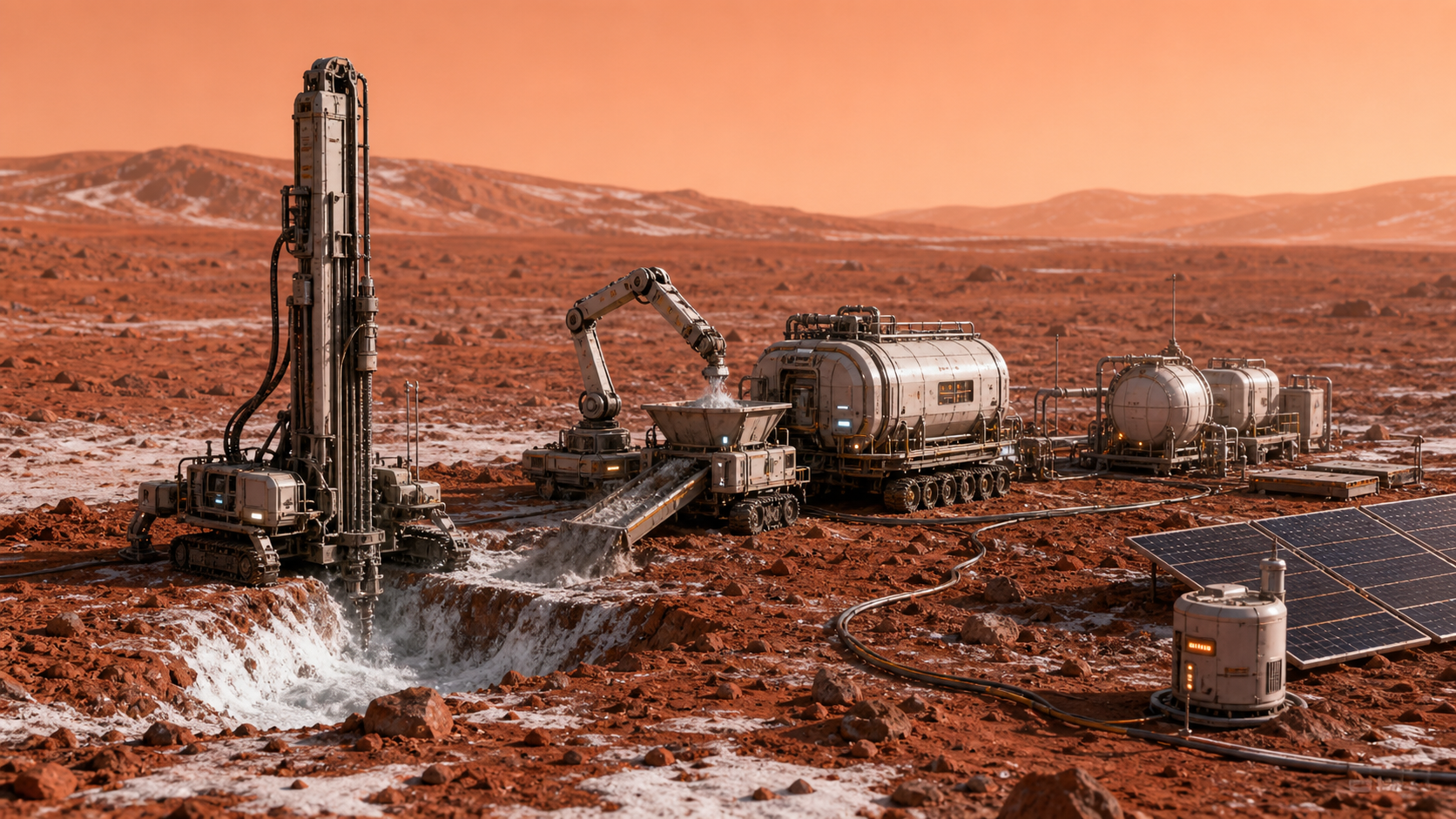
The first major robotic job is not glamorous. It is dirt. Mars regolith can become shielding, berms, landing-pad material, roadbeds, trench cover, and feedstock for construction experiments. Moving it by hand in spacesuits would be slow, risky, and exhausting. Robotic bulldozers, loaders, bucket wheels, drills, compact haulers, and graders can do the heavy work before people arrive.
Regolith handling is also tied to water. Many settlement plans depend on finding and extracting subsurface ice. That requires prospecting, drilling, heating or mechanical extraction, purification, storage, and contamination control. Water can support life, grow crops, make oxygen, provide radiation shielding, and supply hydrogen for fuel chemistry. A robot that can reliably mine icy material is not just a machine. It is part of the settlement’s metabolism.
NASA has studied concepts such as RASSOR, a lightweight robotic excavator designed for low-gravity digging, and the Perseverance rover carried MOXIE, an experiment that produced oxygen from the carbon dioxide in Mars air. These are not complete city systems, but they show the direction: use local resources where possible, and prove small processes before betting human lives on large ones.
The First Builders May Be Inspectors
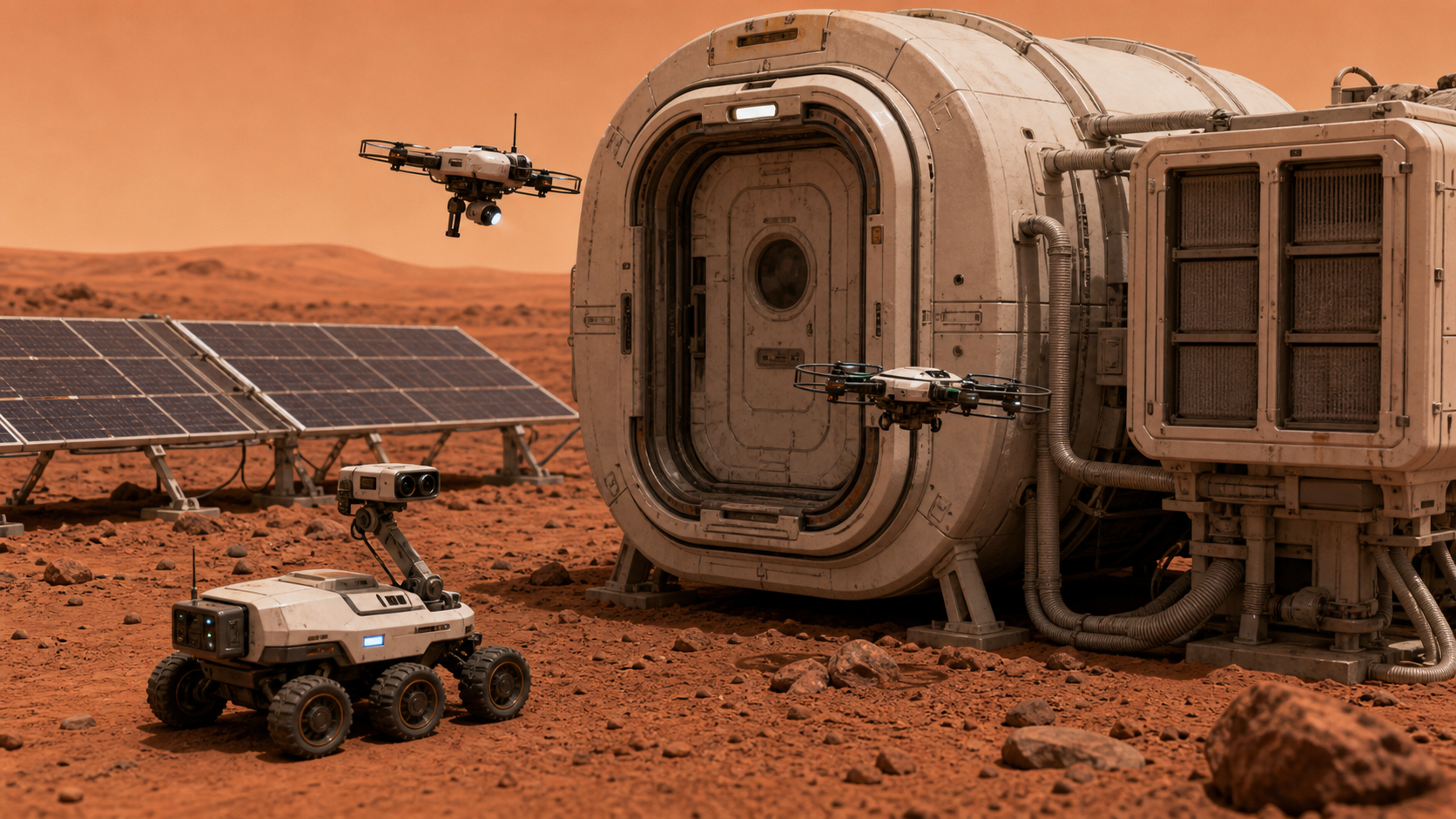
Building is only part of the job. Inspection may be even more important. Mars equipment must survive launch, cruise, entry, descent, landing, thermal cycles, dust, vibration, and months or years of waiting. A pressure seal that looked perfect on Earth may be damaged by landing loads. A power connector may be clogged with dust. A thermal radiator may be shaded by a berm. A rover wheel may crack before any human sees it.
Robotic inspectors can map these problems early. Small rovers can crawl around landing legs and airlocks. Climbing robots can inspect tanks and habitat shells. Flying drones may be difficult in Mars’ thin air, but rotorcraft such as Ingenuity showed that powered flight on Mars is possible at small scale. Future aerial scouts could survey routes, dust deposits, cable paths, and construction zones.
The critical point is not replacing humans forever. It is giving humans a known, instrumented, partially repaired environment when they arrive. The first crew should know which hatch sticks, which pump is noisy, which solar string is underperforming, and which rover needs a spare bearing.
Autonomous Factories Reduce Earth Dependence
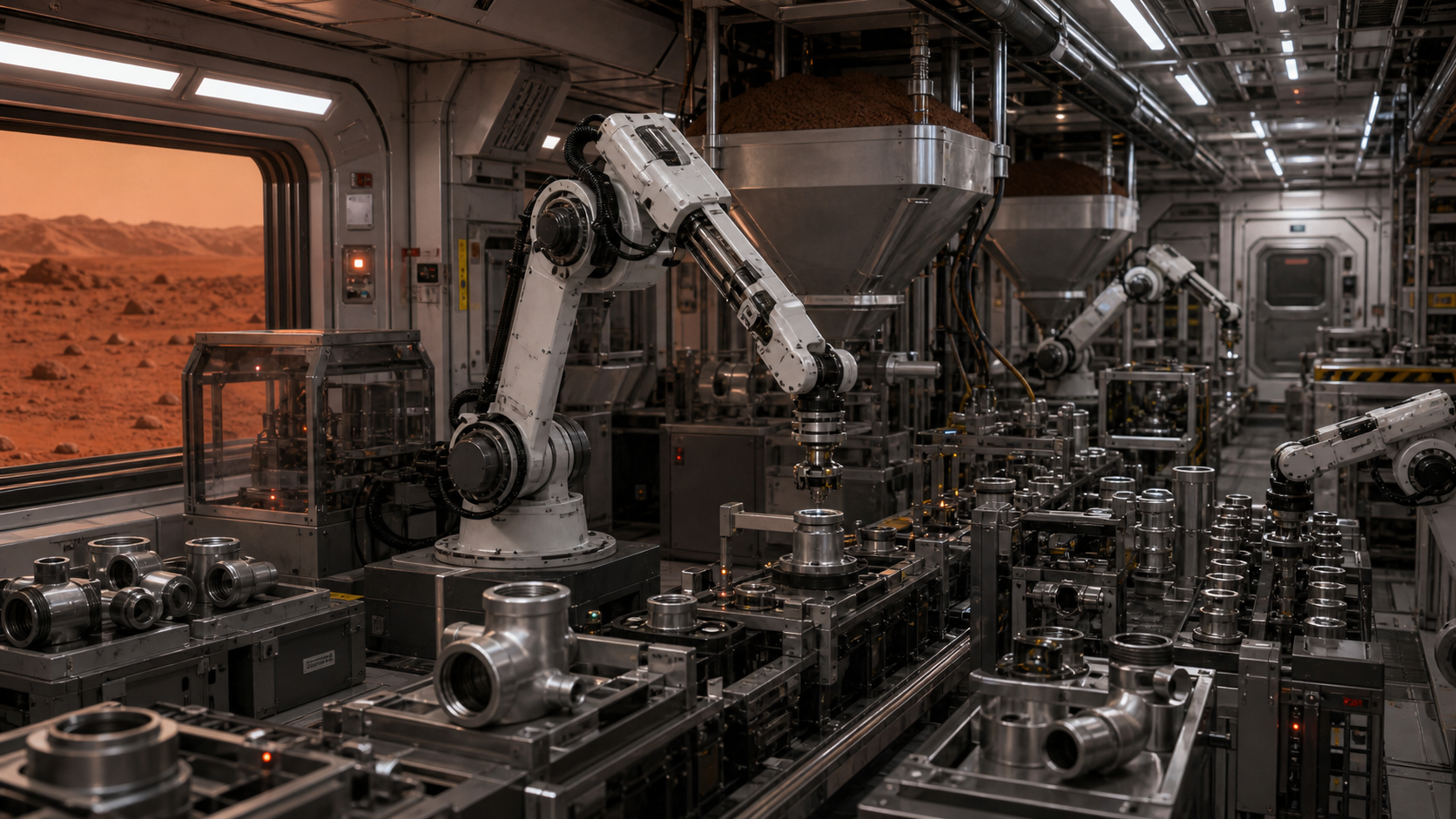
Every Mars city begins as an import economy. Earth sends precision machines, electronics, medicines, seals, sensors, tools, and replacement parts. But shipping delays are long, launch windows are limited, and emergencies do not wait for the next cargo opportunity. The more a settlement can make and repair locally, the less fragile it becomes.
Autonomous manufacturing does not have to start with entire rockets or pressure vessels. It can begin with brackets, pipe supports, simple tools, rover parts, greenhouse trays, regolith blocks, replacement covers, cable clips, insulation panels, and test coupons. Robotic arms, computer-controlled mills, additive manufacturing, sintering, and material sorting can turn stored feedstock and local material into useful parts.
Quality control is the hard part. A printed part used as a shelf bracket is one thing. A printed part used inside a pressure system is another. Mars factories must include inspection, certification, traceability, and conservative rules about where locally made components can be used. Autonomy is valuable only if the settlement can trust the result.
Food Systems Need Robotic Care
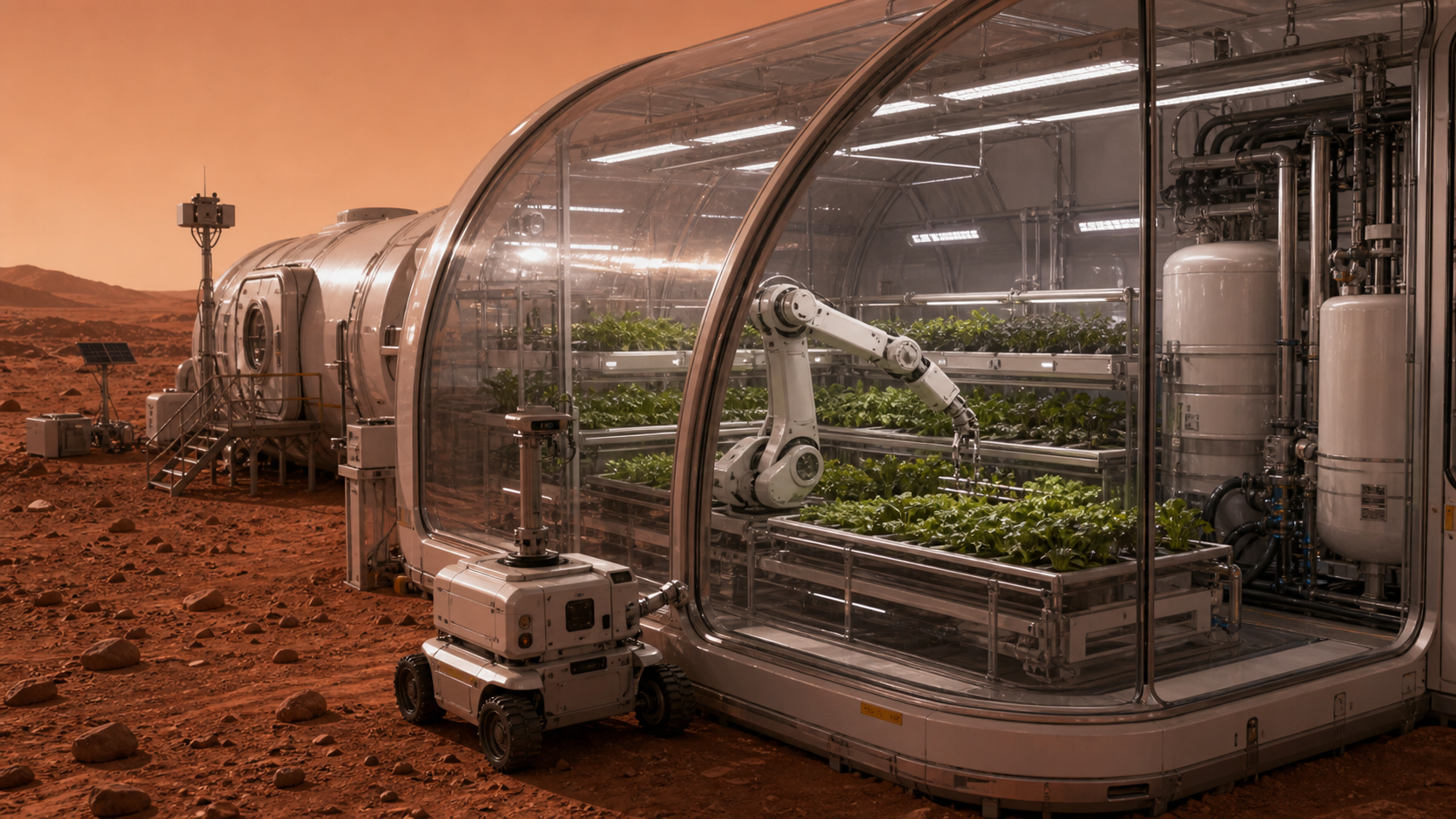
A human crew should not land and discover that the greenhouse leaks, the pumps clog, the nutrient loop drifts, or the crop lighting overheats. If agriculture is part of the life-support plan, robots should operate test greenhouses before people arrive. They can plant, monitor, prune, harvest sample crops, clean filters, detect pests or mold, and report how the system behaves over seasons.
This is not only about food. Plants interact with water recycling, humidity, carbon dioxide, oxygen, microbial control, waste processing, and crew psychology. A robotic greenhouse is a life-support laboratory. If it fails during the pre-crew phase, engineers can redesign the system before anyone depends on it. If it succeeds, the first crew arrives with data, not hope.
AI Monitoring Needs Boundaries
Mars robots will need autonomy because real-time joystick control from Earth is impossible. Commands can take minutes to cross interplanetary distance, and the return signal takes minutes more. Robots must navigate, avoid hazards, prioritize tasks, pause safely, diagnose faults, and sometimes choose the next best action without waiting for Earth.
That does not mean handing over settlement safety to a mysterious black box. The safest autonomy will be layered: clear goals, conservative limits, local sensors, remote supervision, automatic safing, human review, and hard rules for high-risk actions. A robot can decide how to route around a rock. It should not casually repressurize a damaged module, open a contaminated line, or move heavy equipment near a habitat without verified permission.
Good autonomy makes Mars more human, not less. It removes repetitive danger, gathers better data, and lets crews spend their time on decisions, repairs, science, medicine, and community life.
What Remains Unsolved
The hardest robotics problem is reliability at distance. Machines fail on Earth even when spare parts, mechanics, warehouses, and rescue crews are nearby. On Mars, every joint, bearing, battery, sensor, cable, wheel, actuator, and software update becomes part of a long chain of trust. Dust can jam mechanisms. Cold can weaken batteries. Radiation can disturb electronics. A simple repair may require another robot, which may also need repair.
The answer is not one perfect robot. It is an ecosystem: simple rugged machines, specialized tools, redundant fleets, standard connectors, self-test routines, replaceable modules, shared spare parts, and designs that fail gracefully. Mars robots should be boring in the best sense. They should dig, inspect, clean, connect, measure, and report, again and again, before people arrive.
If robots can build enough of Mars first, human arrival changes character. The first settlers step into a prepared, instrumented, partially working world. They still face danger, but not the worst danger: arriving at a dead construction site with no tested shelter. A future Mars city may be remembered by human names, but its first foundations will be robotic.
Leave a Reply