
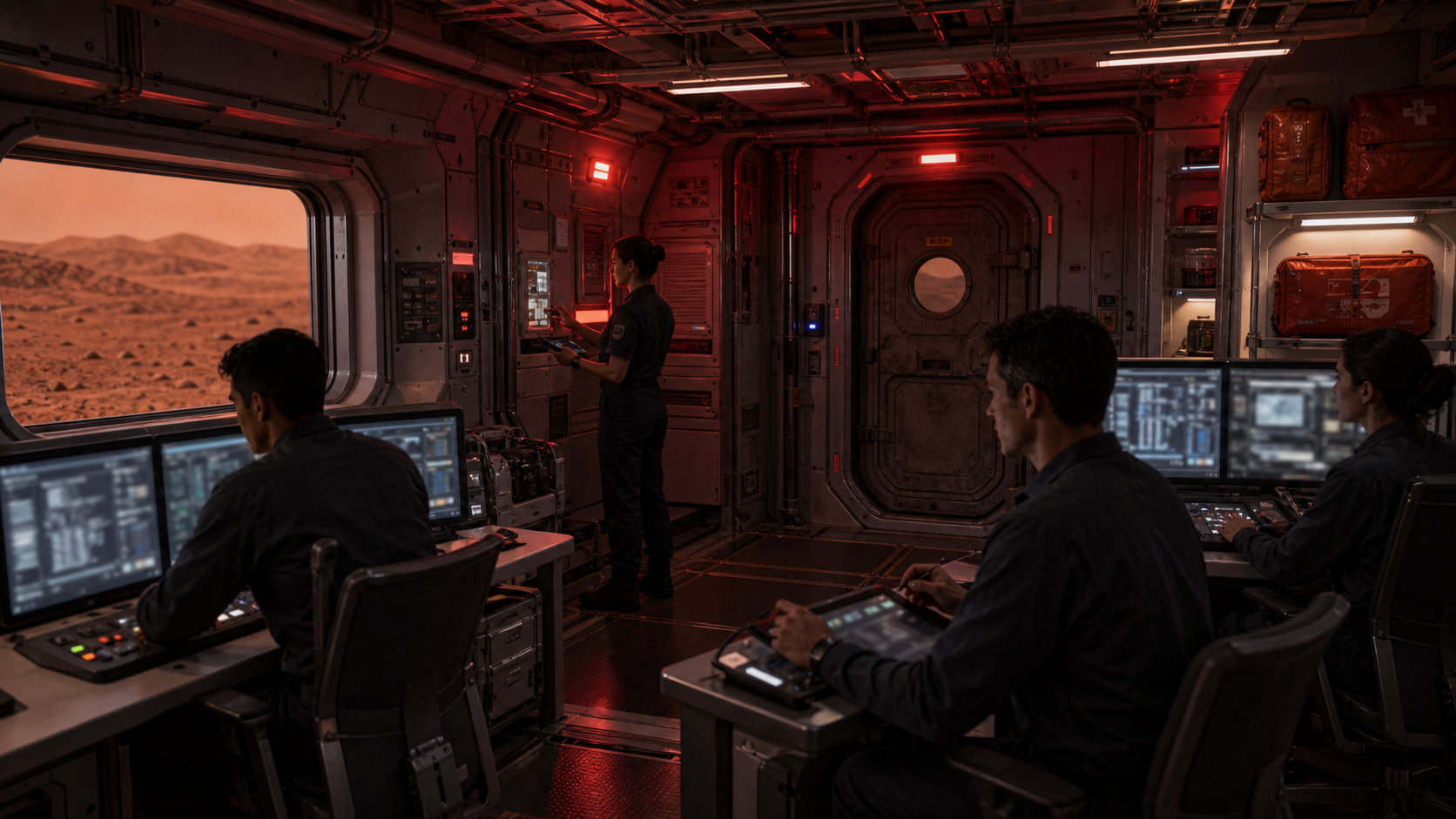
A city on Earth can call an ambulance, evacuate to the next town, buy replacement parts, bring in utility crews, or wait for a national government to send help. A city on Mars cannot. The nearest outside assistance is another planet away, and even the radio call asking for help may take minutes to arrive.
That changes the meaning of emergency. On Mars, a habitat leak is not a building-maintenance issue. Crop failure is not only an agricultural problem. A power outage is not an inconvenience. A medical crisis is not simply a hospital case. Every serious failure threatens the closed loop that keeps people alive.
The good news is that Mars emergencies can be planned for. The bad news is that they must be planned for before the city exists. Survival depends less on heroic improvisation than on boring systems that isolate damage, preserve options, and keep small failures from becoming settlement-wide disasters.
The First Rule Is Isolation
A Mars city must be designed so that one failure does not take everything with it. This principle applies to air, water, power, food, data, medicine, and governance. Compartments, pressure doors, valves, circuit breakers, fire zones, quarantine rooms, spare tanks, local batteries, and redundant communication links are not optional. They are the city’s immune system.
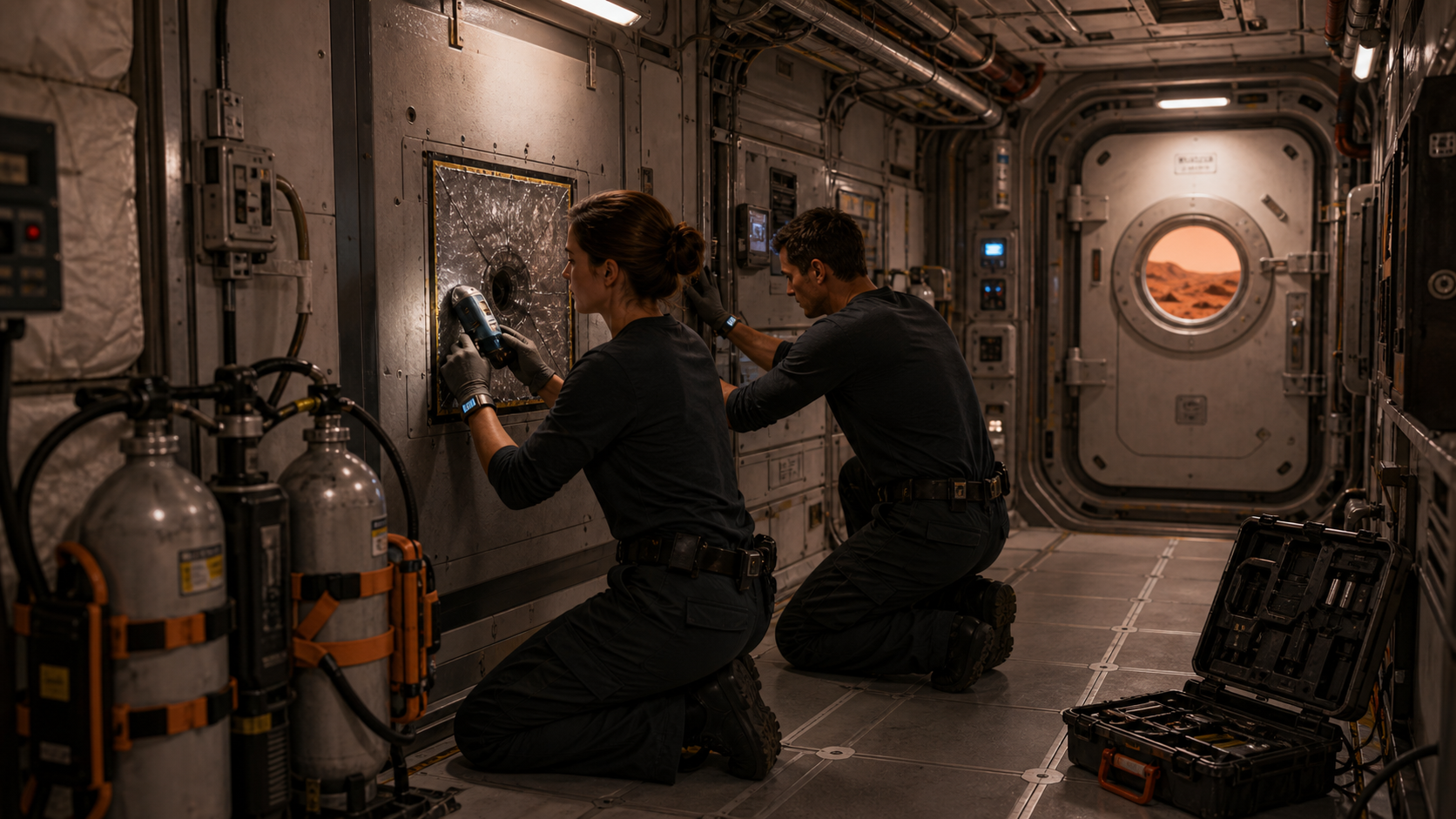
In a habitat leak, sensors should detect falling pressure quickly. Doors should close automatically or by crew command. People should know which masks, emergency oxygen packs, and patch kits are nearest. The damaged zone should be isolated while the rest of the settlement remains pressurized. A leak that becomes a whole-city depressurization is a design failure as much as an accident.
The same thinking applies to water contamination, electrical faults, computer failures, and disease. A city that is too interconnected becomes fragile. A city that can divide itself into safe islands has a chance to recover.
Life Support Failures Are Time Problems
Closed-loop life support changes the clock. If carbon dioxide removal fails, the crew has limited time. If oxygen generation stops, stored oxygen buys time. If water recovery fails, tanks buy time. If humidity control, temperature control, or air filtration fails, the habitat may remain livable for a while, but the margin begins shrinking.
This is why emergency planning should be measured in hours, days, weeks, and resupply windows. How long can the settlement survive if one oxygen generator fails? If two fail? If the water processor is contaminated? If the air scrubbers need parts? If a spare part exists, where is it, who can install it, and what tools are needed?
NASA’s work on life support systems for human spaceflight shows how deeply air, water, waste, temperature, monitoring, and maintenance are linked. A Mars city would need the same discipline at larger scale. The goal is not merely keeping the system efficient. The goal is knowing exactly how much time each backup buys.
Food Failure Is Slow but Serious
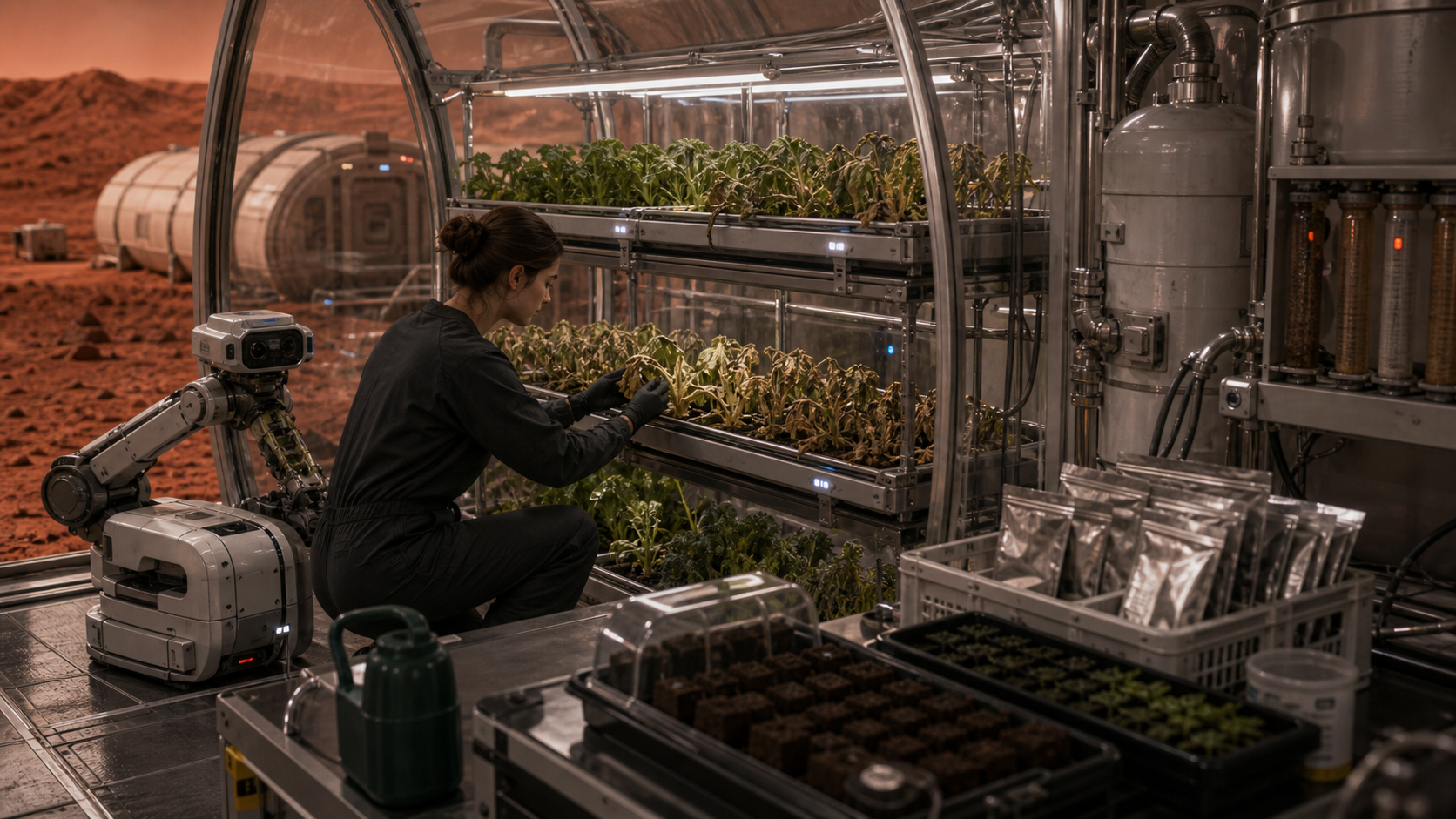
A crop failure is different from an air leak. It may not feel urgent at first. The settlement still has food in storage. People still eat dinner. But if the greenhouse is part of the calorie plan, a disease outbreak, pump failure, nutrient imbalance, mold bloom, lighting problem, or water contamination can create a long emergency.
The response needs layers. Food storage covers the gap. Backup seeds and clean growth media support restart. Separate greenhouse compartments prevent one disease from spreading through every crop. Robots and sensors detect stress early. Algae, fungi, insects, microbial protein, and shelf-stable reserves may provide backup nutrition if leafy greens or staple crops fail.
A mature Mars city would not ask whether the greenhouse can work on a perfect day. It would ask what happens after ten bad days: a clogged filter, a sick technician, a delayed shipment, and a power reduction during a dust storm. Resilience is not yield. Resilience is the ability to lose part of the system and still eat.
Power Loss Can Cascade
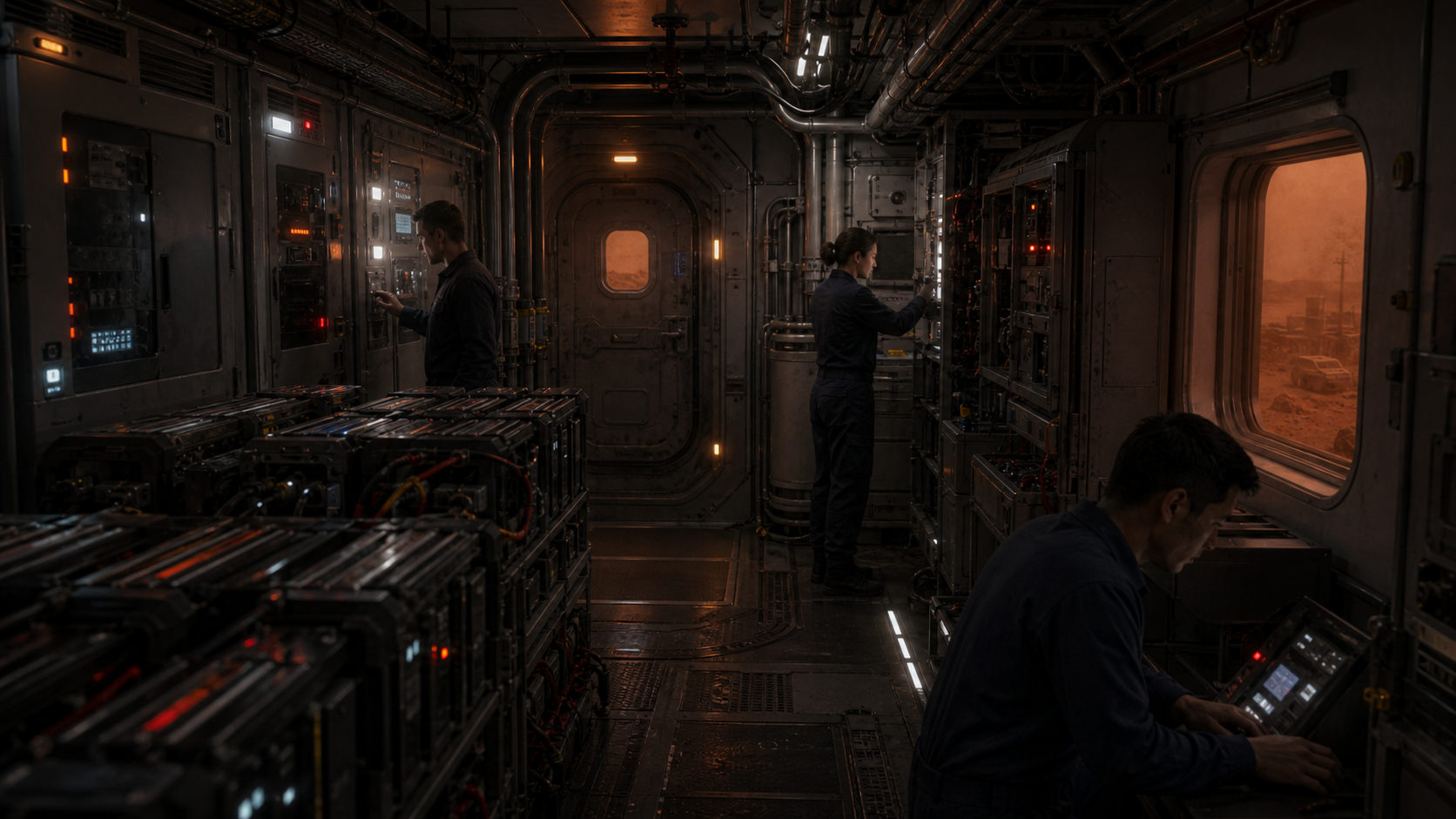
Power is the master dependency. It runs pumps, fans, heaters, computers, lights, valves, rovers, communications, medical equipment, and food production. A serious power failure can become a life-support failure, then a water failure, then a food failure. This is why Mars settlements need microgrids, storage, backup generation, load shedding, and emergency priorities.
A dust storm can reduce solar power. A reactor can shut down. A battery bank can overheat. A cable trench can fail. A software error can mismanage loads. The emergency response must decide which systems stay on first: air circulation, carbon dioxide removal, heat, medical equipment, communications, water, lighting for essential crops, and enough computing to monitor the rest.
NASA’s experience with solar-powered Mars missions shows how dust and power margins can shape survival. A city will need deeper redundancy than a rover. It cannot simply go quiet and hope for sunlight. It must keep people warm, breathing, informed, and organized while repairs happen.
Medical Emergencies Are Also Logistics Problems
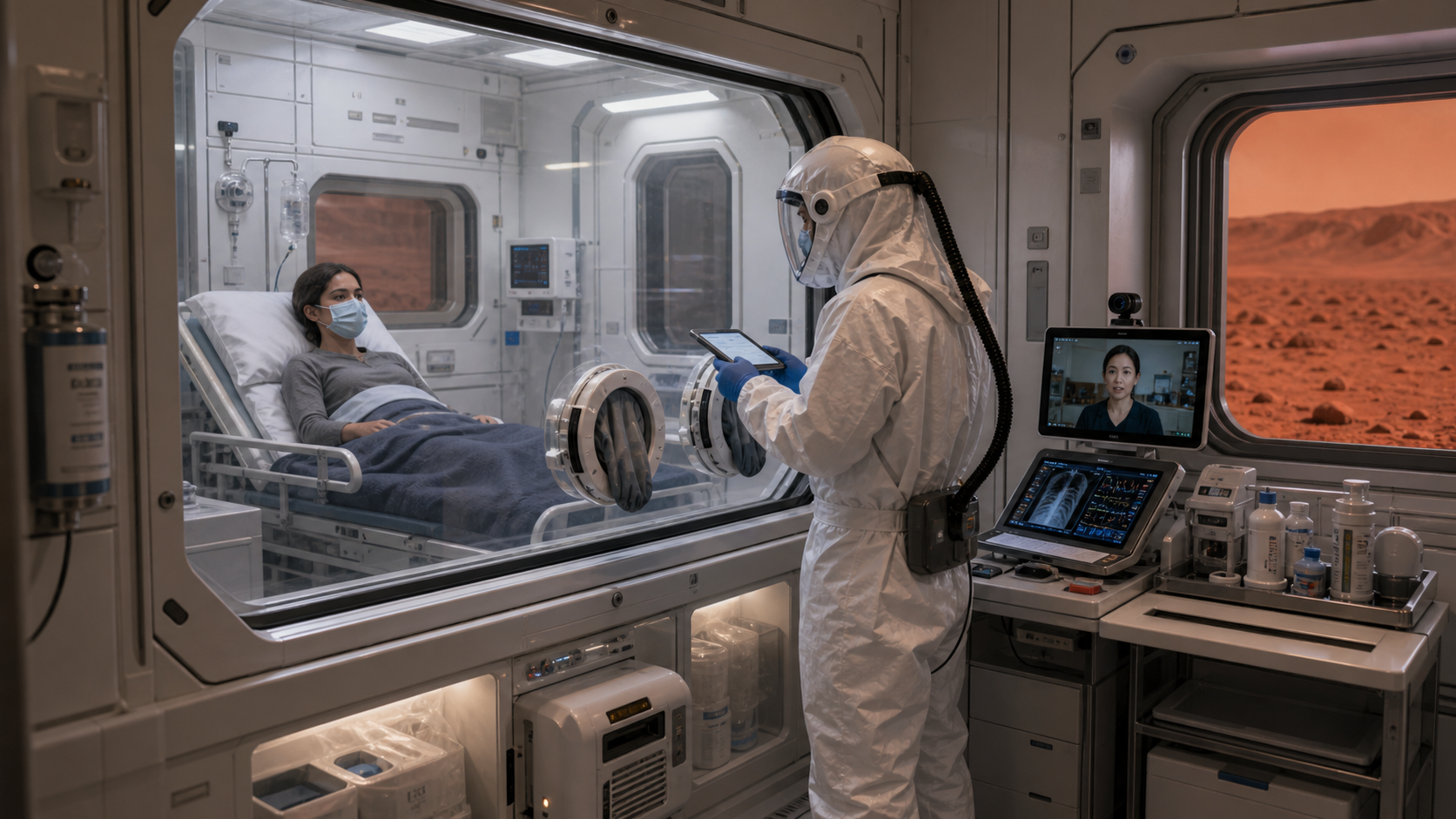
A Mars clinic must handle ordinary injuries and extraordinary constraints. Broken bones, burns, appendicitis, infection, dental emergencies, radiation exposure, mental health crises, pregnancy complications, and infectious disease all become harder when evacuation to Earth is not immediate. Telemedicine helps, but the expert advice arrives through a communication delay and cannot hold the scalpel.
Disease outbreaks are especially complex. A closed habitat shares air, surfaces, food systems, exercise spaces, and social routines. Quarantine rooms, testing supplies, air filtration, protective equipment, sanitation protocols, and backup crews are essential. The emergency is not only treating patients. It is keeping the rest of the life-support workforce healthy enough to operate the city.
Mental health is part of emergency medicine too. A long crisis under confinement can produce fatigue, conflict, fear, sleep loss, and decision errors. Drills should train not only technical actions, but also communication, role clarity, rest cycles, and leadership handoffs.
Communication Delay Changes Governance
Earth can advise a Mars city, but it cannot command every emergency in real time. Depending on planetary positions, one-way light time can range from several minutes to more than twenty minutes. A full question-and-answer loop can take much longer. During a leak, fire, medical event, or power collapse, local leaders must act.
That means emergency governance must be settled before the crisis. Who can order a module sealed if people may be inside? Who decides to ration water? Who stops a risky repair? Who overrides normal work schedules? Who speaks to Earth? Who tells families bad news? These are not only technical questions. They are political and ethical questions.
A safe settlement needs clear authority, transparent rules, recorded decisions, appeal processes for slower emergencies, and a culture that rewards reporting weak signals before they become disasters. The worst emergency system is one where everyone knows the pump sounds wrong, but nobody wants to interrupt the schedule.
What Remains Unsolved
The hardest problem is not imagining emergencies. It is preventing combinations. A crop disease during a dust storm. A medical emergency during a power shortage. A habitat leak while half the maintenance crew is isolated. A software fault that hides a water problem until stored reserves are already low.
Mars safety will depend on simulation, analog missions, digital twins, spare parts, drills, checklists, and conservative design. But it will also depend on humility. Every system should assume that something else is failing at the same time. Every emergency plan should ask what happens if the person trained to fix it is asleep, injured, or quarantined.
A Mars city survives emergencies by being less like a single machine and more like a living organism: compartmentalized, redundant, aware of itself, able to rest one part while another works, and honest about pain before it becomes collapse. The true test of a settlement is not whether nothing ever breaks. Everything breaks. The test is whether the city can keep breathing while it repairs itself.
Leave a Reply